


President Donald Trump hinted at additional measures between the US and Mexico, a day after he vowed that Mexico would soon make “large” agricultural purchases from the US as part of a deal on border security and illegal immigration that allowed Mexico to avoid US tariffs.
“Some things not mentioned in yesterday’s press release, one in particular, were agreed on. That will be announced at the appropriate time,” Trump said yesterday in a series of four tweets about Mexico, the media and other matters.
Three Mexican officials said on Saturday they were not aware of any side accord in the works, and that agricultural trade hadn’t been discussed during three days of negotiations in Washington that culminated in a joint communique late on Friday.
The president also took issue with the contention in a New York Times article that most of the key elements agreed to between the US and Mexico on Friday had been in the works for months.
On Saturday Trump told his 61mn Twitter followers in an all-caps message that Mexico had agreed to “immediately begin buying large quantities of agricultural product from our great patriot farmers” following the border security deal. He retweeted the message overnight.
The State Department communique issued late Friday — entitled the US-Mexico Joint Declaration — also made no mention of agricultural trade as part of the agreement.
The State Department didn’t respond to an inquiry made through its press department. The White House declined to comment or offer proof to back up Trump’s tweet. The Mexican foreign ministry’s press office declined to comment.
President Andres Manuel Lopez Obrador said at a rally in Tijuana near the US border that Mexico should celebrate the “important deal” with the US that removed the threat of tariffs as it was preparing to retaliate. He also didn’t mention agriculture in a speech attended by leading political figures in the country.
If tariffs “had been applied it would’ve caused significant damage to both economies,” he said. “We were being put in a very difficult and uncomfortable position to have to apply the same measures that were going to be placed on Mexican exports.”
Earlier in the week, the Mexican president said that “a mixing of migration with commercial matters” was “unfortunate.”
Mexico is already a large buyer of US farm goods, including corn, soybeans, pork and dairy products. It had given no indication of attempting to find alternative suppliers during the standoff over Trump’s proposed steep tariffs on Mexican goods.
The US Department of Agriculture in May forecast US agricultural exports to Mexico in the current fiscal year at $19.7bn, about 14% of total US farm exports and up from $18.8bn in fiscal 2018. Mexico is second only to Canada as a market for US farm goods.
Increasing Mexico’s purchases from the US beyond current levels wasn’t discussed during the Washington talks, said the three people with knowledge of the deliberations who weren’t authorised to speak publicly.
Mexico has no state-owned agricultural conglomerate to buy food products or handle distribution, or a government program that could buy farm equipment for delivery to producers.
Trump earlier on Friday suggested the talks were covering trade in agriculture, and not just border security issues as members of his administration had said — and that the State Department communique listed. If a deal was made, Trump said at the time, “they will begin purchasing Farm & Agricultural products at very high levels.”
“If we are able to make the deal with Mexico, & there is a good chance that we will, they will begin purchasing Farm & Agricultural products at very high levels, starting immediately. If we are unable to make the deal, Mexico will begin paying Tariffs at the 5% level on Monday!,” Trump’s tweet read.
Trump on Saturday was fund-raising on the back of the Mexican agreement. His campaign sent out a “donate now” email that read in part, “Art of the Deal! Mexico has agreed to help END ILLEGAL IMMIGRATION. Promises Made. Promises Kept.”
Farm states, among the strongest of Trump’s supporters, have been hit hard by the president’s trade war against China, and the threat of additional action against Mexico had some farm-state senators up in arms. The president is expected to travel to the heartland to hold a private fund-raiser in West Des Moines tomorrow.
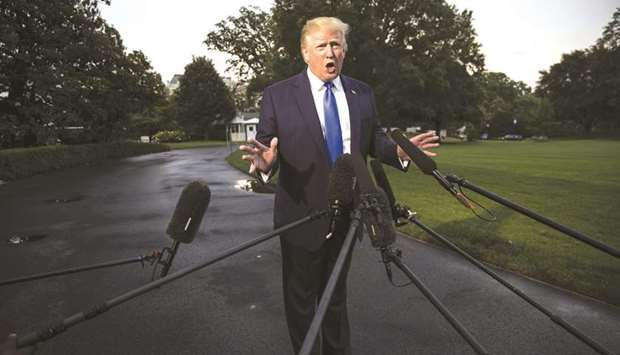
US President Donald Trump speaks to members of the media in Washington, DC. The president took issue with the contention in a New York Times article that most of the key elements agreed to between the US and Mexico on Friday had been in the works for months.