


Prime Minister Theresa May stepped down as leader of the governing Conservatives yesterday, officially triggering a contest to replace her that could see her party embrace a tougher stance on Brexit.
May announced she would step down last month after failing to deliver Britain’s departure from the European Union on time, deepening a political crisis in a divided country struggling to move on from a 2016 referendum on Brexit.
She will continue to work as prime minister until her party elects a new leader, a crowded race that will be defined by Brexit and competing approaches on how to deliver Britain’s biggest foreign policy shift in more than 40 years.
“For the remainder of her time in office, she will be building on the domestic agenda that she has put at the heart of her premiership,” her spokeswoman told reporters.
May exchanged letters with the leaders of the influential 1922 Committee of Conservative lawmakers, according to a statement from the committee.
May is expected to press ahead with a series of policy announcements potentially costing billions of pounds in her final days in Downing Street, in the face of reservations from the chancellor.
The prime minister is keen to salvage some semblance of a domestic legacy from her three-year stint in No 10, which has been overwhelmingly dominated by Brexit.
May’s spokesperson yesterday said: “You heard from the PM recently in setting out that for the remainder of her time in office she will be focused on delivering and building on the domestic agenda that she has put at the heart of her premiership, since she became prime minister.”
May has already responded warmly to the Augur review of higher education funding, suggesting that maintenance grants should be restored. However, Whitehall sources suggest No 10 has clashed with the Treasury about making costly pledges.
Philip Hammond has repeatedly made clear that with a full-blown spending review coming up in the autumn, decisions should be made in the round. Giving evidence to the Treasury select committee in April, Hammond was asked about whether extra resources could be found for key priorities before the spending review kicked off.
“It would be possible, but I do not think it would be a good idea at all,” he said. “The point of a periodic spending review is an opportunity for government, parliament and society more widely to debate priorities, to look at how we allocate scarce resources across the vast range of potential avenues for spending those resources, and to decide what our priorities are for the next period and how we want to allocate resources.” However, that approach did not apply to the £20bn of extra funding for the NHS May announced last year.
Hammond is also nervous about the idea that some of the £27bn of “fiscal headroom” he set aside for Brexit contingencies could be spent, despite the fact that none of the frontrunners for the Tory leadership have ruled out no-deal.
Asked whether May had clashed with the chancellor, the prime minister’s spokesperson said: “They meet regularly to discuss spending priorities. I wouldn’t get into the nature of the discussions.”
A Downing Street source played down the idea that any announcements would amount to a spending splurge, saying: “We’ll want to keep delivering for people, but what we haven’t said is whether/how much that costs.” No 10 slapped down the chancellor on Thursday, after the Financial Times revealed a leaked letter in which he had said May’s promise to hit net zero carbon emissions by 2050 would cost £1tn in lost economic output.
“Obviously, I’m not getting into the contents of the letter, but broadly there are a lot of figures out there on this issue that don’t factor in the benefits or consider the costs of not doing this,” said the prime minister’s spokesperson.
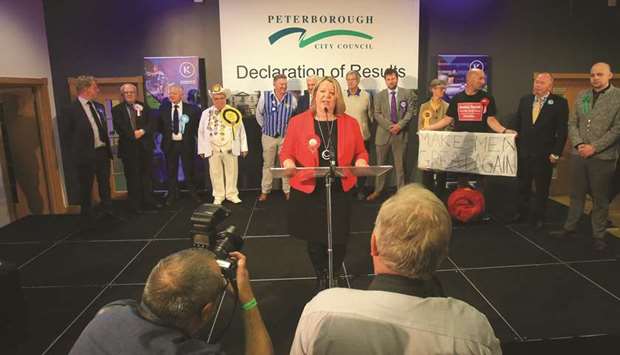
Lisa Forbes of the Labour Party accepts her win for the local seat after all votes are in and counted at the Kingsgate Conference Centre in Peterborough, England.