


Russia has told the US that it has withdrawn most of its personnel from Venezuela, US President Donald Trump said yesterday, two months after telling Moscow to “get out” of the crisis-plagued Latin American nation.
“Russia has informed us that they have removed most of their people from Venezuela,” Trump tweeted during a state visit to Britain.
US-Russian tensions have spiked over the months-long standoff in Venezuela, where Washington has thrown its weight behind a campaign to oust the Moscow-backed socialist president, Nicolas Maduro.
Trump called on Russia to “get out” of Venezuela in March, after Moscow — in a significant show of solidarity for Maduro’s badly isolated government — deployed around 100 soldiers to the country.
The Kremlin has not responded officially to Trump’s claim.
However, state defence contractor Rostec played down any changes, dismissing an earlier report in The Wall Street Journal saying that the overall Russian presence had been reduced from as many as 1,000 personnel to a few dozen.
The numbers cited by the Journal “were exaggerated dozens of times over,” a statement from Rostec said.
“As for technical specialists, they periodically arrive in the country for the repair and maintenance of previously supplied equipment. For example, technical maintenance was recently completed on a batch of aircraft,” Rostec said.
A Rostec spokeswoman said “around 10 people work in our Venezuela office and that’s always been this way.”
According to the Journal report, however, Rostec once had a far bigger presence in Venezuela, training troops and advising on weapons contracts.
That relationship has withered as Moscow recognises the inability of Caracas to pay.
Washington has subjected Venezuela, a once rich country whose economy is now in a state of chaos, to economic sanctions in an attempt to force Maduro from power.
Meanwhile, a group of countries pushing for elections in Venezuela yesterday agreed to reach out to President Nicolas Maduro’s international backers, broadening diplomatic efforts to reach a breakthrough.
The initiative was announced following a meeting at the United Nations between the foreign ministers of Peru, Chile and Canada with EU foreign policy chief Federica Mogherini and their counterparts from Portugal and Uruguay.
“We decided to put in place an outreach programme with the countries that are directly involved in supporting the illegitimate regime of Nicolas Maduro to be part of the solution,” Peru’s Foreign Minister Nestor Popolizio told reporters.
He did not provide details.
Russia, China, Cuba, Bolivia and Nicaragua have staunchly defended Maduro and denounced the US for backing opposition leader Juan Guaido after he declared himself interim leader in January.
The meeting between the Lima Group, which opposes Maduro, and the EU-backed International Contact Group came just days after Norway hosted the first face-to-face talks between Maduro’s representatives and a delegation sent by Guaido.
In a joint statement, the foreign ministers called for a peaceful transition leading to free and fair elections in Venezuela.
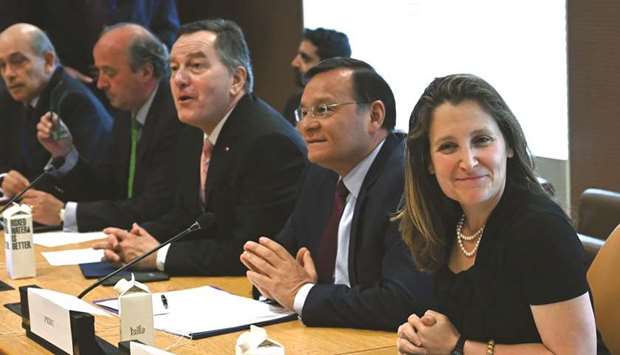
Chrystia Freeland, Minister of Foreign Affairs of Canada (right), attends a meeting on the Venezuela crisis with representatives of the Lima Group and the International Contact Group at the United Nations in New York yesterday.