


Palestinian worshippers clashed with Israeli police at a highly sensitive Jerusalem holy site yesterday as an Israeli holiday coincided with the final days of the holy month of Ramadan.
Muslim worshippers at the Al-Aqsa Mosque compound were angered over Jewish visits to the site holy to both religions.
According to police, protesters barricaded themselves in the mosque, from where they threw chairs and stones at forces who “dispersed” them.
The Muslim Waqf organisation which oversees the site said police used rubber bullets and pepper spray, adding that seven people were arrested and 45 were wounded.
It said that police shut the mosque’s doors and chained them.
After the clashes, police spokesman Micky Rosenfeld said calm had returned and visits continued.
Al-Aqsa Mosque director Omar al-Kiswani accused Israel of violating an agreement not to allow such visits during the last days of Ramadan.
He said that around 1,200 Jews visited the site yesterday, while a Jewish organisation that arranges visits there reported a similar number.
The clashes took place as Israelis marked Jerusalem Day, which commemorates the country’s capture of the city’s mainly Palestinian eastern sector in the 1967 Six-Day War. This year’s holiday coincided with the final days of Ramadan, the month of fasting.
The Al-Aqsa compound, is located in east Jerusalem and its status is one of the most sensitive issues in the Israeli-Palestinian conflict.
Yesterday’s visit was the first time since Tuesday that Jews were allowed into the site, according to activists.
Israeli Public Security Minister Gilad Erdan said his policy was to do everything possible to keep the site open to visits, especially for Jerusalem Day.
He said preparations to avoid serious unrest included arrests ahead of yesterday based on intelligence in addition those in connection with the clashes.
Jordan, the custodian of the holy site and one of only two Arab countries with a peace treaty with Israel, condemned what it said was Israel’s “flagrant violations” there, calling the visits “provocative intrusions by extremists.”
Such actions risked setting off violence in the region, a statement from Jordan’s foreign ministry said.
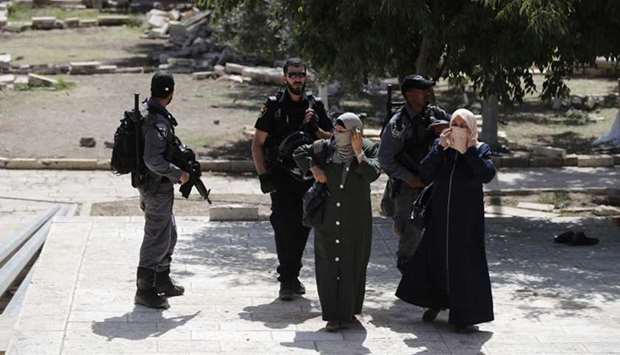
Israeli security forces stand guard behind Palestinian women visiting the Al-Aqsa Mosque compound, in the Old City of Jerusalem, yesterday.