


Pope Francis has made an impassioned plea for Europe to stick together and revive the ideals of its founders, saying yesterday that ideologies and fear-mongering politicians were threatening its very existence as a bloc.
His comments to journalists on the plane while returning from a three-day trip to Romania, one of the more recent European Union members, were his first since European elections last month.
Francis, who was asked about the elections, Italian far-right leader Matteo Salvini and other European topics, urged believers to pray for European unity and non-believers to hope for it “from the bottom of your hearts”.
The far-right and nationalists in Italy, Britain, France and Poland came out on top in their national votes, shaking up politics at home but failing to dramatically alter the balance of pro-European power in EU assembly.
“If Europe does not look carefully to future challenges, Europe will dry up. Europe is ceasing to be ‘Mother Europe’ and is becoming ‘Grandmother Europe’. It has aged. It has lost the goal of working together,” he said. “Someone could ask under their breath ‘Is this perhaps the end of a 70-year adventure?’”
Francis avoided directly criticising Salvini, leader of the right-wing League party who has often sparred with him on migration issues, saying that the reason they had not yet met is because Salvini had not asked for an audience.
Francis also stressed that his comments should be taken generally about Europe and were not specific to Italy, saying it is near impossible for him to understand Italian politics.
“We have to help politicians to be honest. They should not carry out (political) campaigns under dishonest banners, with calumny, defamation, scandals,” he said, without naming any countries or giving examples. “Many times they sow hate and fear. A politician should never sow hate and fear, only hope – just and demanding – but always hope.”
He said that Europe had to again “take up the mysticism” of its founding fathers and overcome divisions and borders.
“Please let’s not let Europe be overcome by pessimism or by ideologies, because Europe is not being attacked by cannons or bombs in this moment, but by ideologies – ideologies that are not European, that come either from outside or which stem from small groups in Europe,” he said.
Francis urged Europeans to remember how the continent was divided and belligerent in the years leading up to both world wars in the 20th century.
“Please, let’s not return to this. Let’s learn from history. Let’s not fall in the same hole.”
Earlier, the Pope apologised to the Roma people for the Roman Catholic Church’s “discrimination” against them as he wrapped up a visit to Romania.
Making up around 10% of Romania’s 20mn people, many Roma are marginalised and live in poverty and have suffered centuries of discrimination and insults.
“I ask forgiveness – in the name of the church and of the Lord – and I ask forgiveness of you. For all those times in history when we have discriminated, mistreated or looked askance at you,” the Pope said in a speech to the Roma community in the central town of Blaj.
“My heart, however, is heavy. It is weighed down by the many experiences of discrimination, segregation and mistreatment experienced by your communities. History tells us that Christians too, including Catholics, are not strangers to such evil,” he said.
“Indifference breeds prejudices and fosters anger and resentment. How many times do we judge rashly, with words that sting, with attitudes that sow hatred and division!”
Earlier, the Pontiff beatified seven Greco-Catholic bishops jailed and tortured during the Communist era.
“The new blessed ones suffered and sacrificed their lives, opposing a system of totalitarian and coercive ideology,” he told some 60,000 worshippers attending mass on a “Field of Liberty” in Blaj.
“These shepherds, martyrs of faith, garnered for and left the Romanian people a precious heritage which we can sum up in two words: freedom and mercy,” added Francis, while praising the “diversity of religious expression” in mainly Orthodox Romania.
Regime officials detained the beatified bishops overnight on October 28, 1948, accusing them of “high treason” after they refused to convert to Orthodoxy.
The Greek-Catholic Church was outlawed under 1948-89 Communist rule.
The bishops died of maltreatment, some still in jail, others in confinement in an Orthodox monastery.
They were then buried in secret – to this day the whereabouts of four of their graves is unknown.
The bars of the cells where they were held were symbolically incorporated into the throne built specially for the papal visit.
The bishops followed the Eastern Rite Catholic Church which emerged from an Orthodox schism at the end of the 17th century when the central region of Transylvania was part of the Austro-Hungarian empire.
While retaining Orthodox practices, they recognised Roman Catholic papal authority – unacceptable for the Communist regime which took power following World War II.
Under a 1948 decree formally abolishing the Eastern Catholic churches, Greco-Catholics were forcibly obliged to return to the Orthodox fold.
Under such stark political repression, most Romanian Catholics – who numbered more than 1.5mn in 1948, abandoned their faith and their community has shrunk to around 200,000 today in a country of 20mn, almost nine in 10 of whom profess Orthodoxy.
The politics which has seeped through Romania’s modern religious history has poisoned inter-faith relations – even if the papal visit has softened feelings to a degree.
“No matter where we go, to the town hall, to the police or to school, doors get closed,” a 72-year-old Roma, who gave his name as Ion, told AFP.
Roma, originating from northern India, suffered around five centuries of slavery before the practice was formally abolished in 1856.
They remain a mainly poor and marginalised community – even if recent years have seen roads paved and homes getting running water and electricity.
Although Romania has developed apace since obtaining EU membership in 2007 there remain some “urban or rural ghettos where nothing has changed”, according to sociologist Gelu Duminica, who heads the anti-discrimination Impreuna (Together) association.
Duminica and others in Blaj saw it as no coincidence that Francis, often seen as a defender of the rights of the most marginalised, chose the Barbu Lautaru district of Blaj, whose inhabitants are mainly Roma, to launch his appeal for tolerance and social inclusion.
“The pope’s visit is a message for those who are marginalised, disregarded or not accepted by others,” said Mihai Gherghel, an eastern Catholic priest, who supervised the construction of the Blaj church where Francis celebrated Sunday mass.
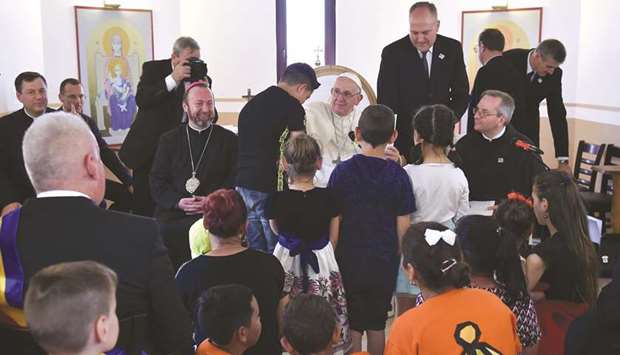
Pope Francis meets members of the Roma community in the Barbu Lautaru district of Blaj, Romania.