


Bharatiya Janata Party (BJP) president Amit Shah yesterday took charge as the 30th federal home minister. The 55-year-old leader succeeded Rajnath Singh and assumed charge a day after he was assigned the home portfolio after Prime Minister Narendra Modi’s government returned for a second term in office.
The leadership change in the high-profile ministry is expected to usher in decisiveness and an iron-hand approach to terror, insurgency and secessionism, analysts said.
While Rajnath Singh had given a free hand to security forces in Jammu and Kashmir, resulting in heavy casualties among militants, Shah is expected to be proactive and lead from the front.
With his appointment as the home minister, Shah’s policy on Kashmir will be crucial, the analysts said. Security and development initiatives are likely to be a major focus in Kashmir ahead of assembly elections in October-November this year.
Shah’s role will also be significant in bringing clarity on how the government wants to address the issue of Article 35A in Kashmir. Besides, he will face the challenge of keeping up pressure on militants and ensure an incident-free Amarnath Yatra.
Completion of the NRC (national register of citizenship) exercise in Assam within the deadline, set by the Supreme Court, is also an immediate challenge. Also, Shah faces the task of getting the Citizenship Bill passed by the Rajya Sabha, while ensuring that it does not cause unrest in Assam and other northeastern states.
Shah was welcomed yesterday by Home Secretary Rajiv Gauba and Intelligence Bureau chief Rajiv Jain as he reached his North Block office. He was also felicitated by new Ministers of State for Home, G Kishan Reddy and Nityanand Rai, who also took charge yesterday.
Soon after taking charge, Shah called a high-level meeting, involving the home secretary, the IB chief and other senior ministry officials, to take stock of internal security.
He was briefed about works of different divisions. He is expected to review division-wise presentation at the ministry, starting next week.
Shah, who headed Gujarat’s Home Ministry when Modi was the state chief minister, may need to adopt different approach as the central government is a different pitch where a minister has to take the states and agencies along. He will have to be more accommodative of views of police forces and agencies while taking decisions.
Under his leadership, central forces can be expected to make further inroads into Maoist bastions, while placing no premium on talks with insurgents where their demands impinge on sovereignty or constitutional parameters.
As Gujarat home minister, Shah was said to be the force behind drafting of GUJCOCA, the first anti-terror law by the state. The law, however, was not approved by the then Congress-led central government.
Shah has pursued agriculture while being a political and social worker. Born in an affluent Gujarati family in 1964 in Mumbai, Shah lived and studied in his village Maansa in Gujarat until the age of 16.
He was a member of the Gujarat assembly from 1997 to 2017 and served as a minister in the Gujarat government from 2002 to 2010, and held key portfolios, including Home, Transport, Prohibition, Parliamentary Affairs, Law and Excise.
In August, 2017 he was elected to Rajya Sabha, the upper house of parliament.
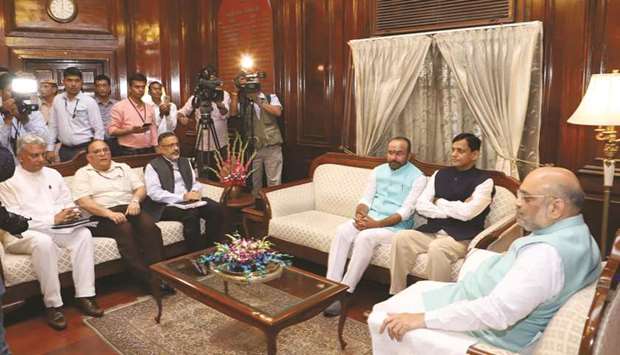
Home Minister Amit Shah meets his deputies G Kishan Reddy and Nityanand Rai and other officials after taking charge in New Delhi yesterday.