


A top official of Doha Bank has underscored the importance of achieving the UN’s Sustainable Development Goals (SDGs) during a convocation ceremony for the Class of 2019 hosted recently by the Great Lakes Institute of Management at the Chennai Trade Centre.
“Life is meaningless without recognising contribution to society. We have a social responsibility and should understand the importance of SDGs and aim to achieve them,” said Doha Bank CEO Dr R Seetharaman during the ceremony where India’s vice president, M Venkaiah Naidu, delivered the convocation address.
“Sustainable Development Goals such as no poverty, zero hunger, good health and well-being, quality education, gender equality, and climate action are impacted by technology.
“Young professionals are going to set new standards in various fields taking into consideration the above trends and I look forward to this. Thereby this will contribute to their happiness and also thereby to the growth of economies.
The gross domestic product to gross domestic happiness is the new world order,” said Seetharaman, who was one of the ceremony’s guests of honour, together with Global Research Alliance president and former CSIR director general, Dr R A Mashelkar.
In a speech, Seetharaman stressed: “We are in an interconnected and interdependent world. Globalisation, technology, reregulation, and consumerism are the keys. This world is shrinking as we drive towards value based system and towards knowledge-based society.
“That is the world we are in. We are setting new standards wherein the world is measurable, manageable, and controllable, and sustain the values what we have inherited as a heritage civilisation and culture. The world is enduring for generations to come and for happiness to come.”
On the global and Indian domestic scenario, Seetharaman cited IMF figures saying, global growth is now projected at 3.3% in 2019, while growth in advanced economies is projected at 1.8% in 2019, and the emerging market and developing economy group growth is expected to be 4.4% this year.
“A further escalation of trade tensions and the associated increases in policy uncertainty could further weaken growth. According to IMF April 2019 data, India’s growth is projected to pick up to 7.3% in 2019, supported by the continued recovery of investment and robust consumption amid a more expansionary stance of monetary policy. India’s consumer price eased to 2.92% in April 2019.
“The Indian rupee is near 70 levels against the dollar. The key factors such as productive middleclass population, infrastructure development, buoyant consumer market, significant Internet users, and mobile connections ensure that India’s growth story is intact in the near future.”
Highlighting emerging trends in technology, Seetharaman said the fourth industrial revolution combines advanced technologies in innovative ways, “dramatically reshaping the way people live, work and relate to one another.”
“Various industries are getting redefined, the health sector can be reimagined, the work space is undergoing changes, robotics and artificial intelligence are going to play important roles, and the customer will be more empowered in the digital environment.
“Banks need to manage the change by redefining their business models and to manage various stakeholders such as customers, regulators, and shareholders.
The question which comes up is how do we regulate technology companies? Customers are information centric and not location centric. To adapt to digital changes, either you need to be quick or dead. Realignment of resources will happen in the light of technology developments,” he said.
On cryptocurrencies, Seetharaman said currencies are a barometer of economy and should not be tool for speculation.
“Technology should be an enabler and not a medium for exchange. If cryptocurrencies are measured and managed within a framework then it is acceptable. Technology is going to be an enabler for sustainable development. A 5% increase in digital access could reduce consumption-based CO2 emissions by 1.6%,” he continued. On knowledge society and value systems, Seetharaman said a knowledge society “can never fail.”
“You as students today are going to equip yourself with value systems for generations to come. Not only do we want to create a better world, we want to create a better citizenship to ensure the world is enduring its values which is created by God.
We have to recognise that change in global make up is real and risk is real as well. Risk is getting redefined today.
“In terms of corporate, stakeholder’s values and public private partnership models are evolving. It is also about setting a goal or vision for your young mind and the direction you want.
Think first you will have it. Set your vision in your mind and work to execute it. You will be able to overcome the obstacles and move forward,” he said.
He added: “Value system is all about developing the habit of hard work and it will take you to places. Look at climate and global warming. We all have to participate in it to make a better world. We should believe in the concept of One World and we are global citizens.”
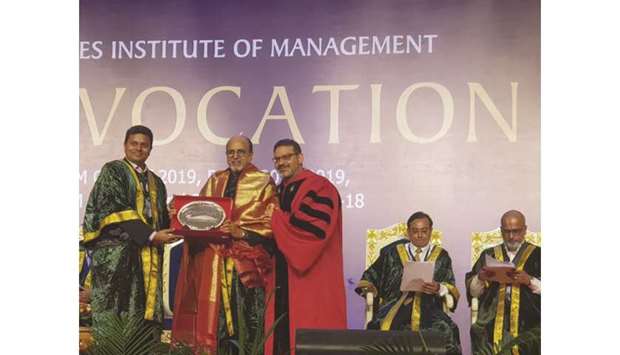
Doha Bank CEO Dr R Seetharaman receiving a token during the convocation ceremony.