


In the old days, you would open the door, and it would be a hive of activity. Now it’s all closed down,” sighs 89-year-old Agida Lucia.
She gazes down a paved road winding through the vegetation, and a smile returns to her lips as the memories flood back. “Over there was the canteen. Up there, the foreman’s office. There was a terrace and a big house. There were the seamstresses, the hospital, the cinema — it was grand.”
Time has not been kind to Agostinho Neto, where once cocoa was shipped out to the world.
From the end of the 19th century to the middle of the 20th century, the 30 cocoa and coffee “rocas” (pronounced ro-ssas), or plantations, on Sao Tome and Principe were at their zenith.
Before World War I, the rocky Portuguese-ruled archipelago in the Gulf of Guinea, off Africa’s western coast, was the world’s leading cocoa exporter.
“There were 20,000 inhabitants in the villages and 33,000 living in the rocas, which had immense economic and political power,” said Fernando d’Alva, a historian and professor at the University of Sao Tome and Principe (USTP).
“The rocas were perfectly organised. People lived better inside them than outside, they had electricity, medical care, the railway and luxuries — as well as a well-oiled feudal system.”
No Sao Tomeans worked on the plantations themselves but some did hold management positions.
The rocas’ agricultural workers came from other African nations, as Sao Tome had a steady supply of slaves passing through as the last staging post on the trade route before ships left for the Americas.
After the slave trade was abolished in 1876, the workers became “contract” employees, brought — often by force — from mainland colonies Angola and Mozambique, as well as Gabon and the Congo.
Independence came to Sao Tome and Principe in July 1975, 14 months after a movement among officers in the Portuguese armed forces led to a military coup in Lisbon toppling an authoritarian regime in favour of democracy.
It is hard to match the state of the plantation today in what is now one of the poorest countries in the world with the glorious recollections conjured up by an elderly former employee. Whatever is left of the prosperous past has been looted or is rotting away as the forest takes over.
“In the old days, we would work a lot, but we could eat every day,” recalled Lucia, who is of Angolan origin.
“Today, everyone lives their own life, nobody helps each other. We live here like animals — if you have nobody to give you food, you die of starvation.”
While her 19-year-old granddaughter Sheila prepares snails for eating, the old lady fancies that “things could go back to how they were, that the Portuguese return.”
Sheila expresses nostalgia for this past she never knew, saying that she would like to study law and fight for “heritage”. That heritage would include the hospital, described by another resident with a motorbike-taxi as “one of the best on Sao Tome... The state’s to blame for doing nothing to keep it in shape.”
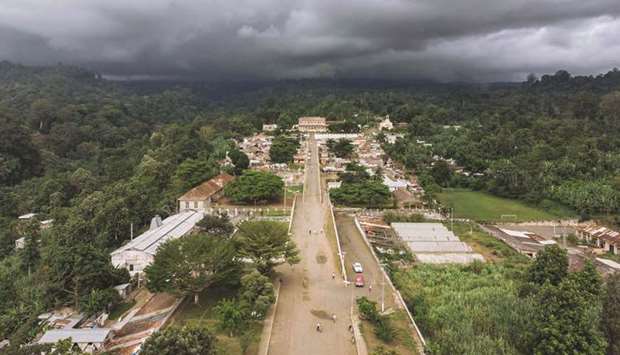
An aerial view of the Roca Agostinho Neto, an abandoned cocoa plantation of Sao Tome and Principe.