


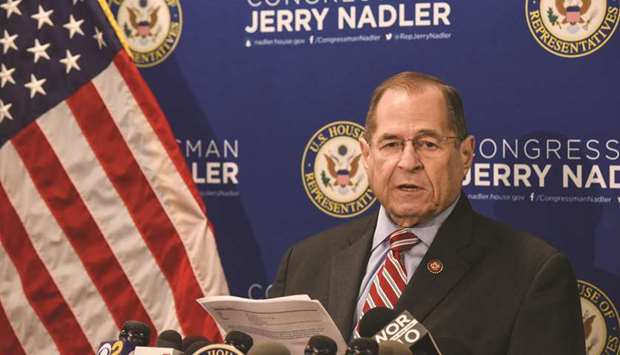
House Judiciary Committee chairman Jerrold Nadler plans to have Special Counsel Robert Mueller testify publicly before Congress even if he doesn’t say anything beyond what is in his 448-page report on the Russia investigation.
“We will have Mr Mueller’s testimony,” the New York Democrat said in response to a question yesterday on WNYC radio.
Nadler’s push to bring Mueller before the panel for a televised hearing is the latest twist in what had been weeks of negotiations with the special counsel about his testimony.
Mueller made a surprise on-camera announcement on Wednesday at the Justice Department with a clear message that he did not want to testify.
“The report is my testimony,” Mueller said. “I would not provide information beyond that which is already public in any appearance before Congress.”
However, Nadler said that most people are not going to read the report, and President Donald Trump, Attorney General William Barr and others are “lying” about what’s in it.
It’s “very important that he, to a television audience and the American people, state it, that he answer questions about it, even if there’s no new information”, Nadler said.
“I think it’s important for the American people to see and to hear what the report found and hear questions about it,” he added. “Part of the function of Congress, just the same as Watergate hearings 40 years ago, to have a dialogue with the American people so people can make informed decisions and know what’s going on.”
On Wednesday, Nadler had declined to answer directly a question about whether he would subpoena Mueller to testify, saying instead that the special counsel “told us a lot of what we need to hear today”.
On the rest of the panel’s investigation, Nadler said he would talk to his colleagues when the House returns to session next week about the possibility of launching an impeachment inquiry, a move that would give the panel additional legal powers “to some extent”.
Nadler said that the committee would be telling the story through hearings and investigations to see if the American people support impeachment proceedings against Trump.
“Impeachment is a political act and it has to have the support of the American people,” Nadler said.
Nadler also said that Mueller is “leaning over too far backwards” when he didn’t want to conclude Trump committed a crime if he couldn’t be charged and therefore couldn’t defend himself in court.
“I think that he could have accused him anyway, period,” he said.
Yesterday Attorney-General William Barr said Mueller “could have reached a decision” on whether Donald Trump is guilty of obstruction of justice – an implicit criticism of Mueller’s refusal to clear Trump of criminal activity.
In an interview with CBS News, Barr also contradicted the president over whether Obama-era officials committed treason.
Trump has made repeated, vague, assertions that the Federal Bureau of Investigation (FBI) committed treason under Obama.
On Wednesday, in a move interpreted by some as an invitation for Congress to impeach Trump, Mueller said his team had deliberately not made a determination “as to whether the president did commit a crime”.
Mueller said his decision not to formally state his opinion over whether Trump broke the law was down to justice department policy.
Speaking to CBS News, Barr said he disagreed with Mueller.
“I personally felt he could’ve reached a decision,” Barr told CBS. “The opinion says you cannot indict a president while he is in office, but he could’ve reached a decision as to whether it was criminal activity.”
“But he had his reasons for not doing it, which he explained. And I am not going to, you know, argue about those reasons,” the attorney-general added.
Mueller’s report identified 10 incidents where Trump attempted to obstruct justice.
The special counsel said justice department policy meant that a “president cannot be charged with a federal crime while he is in office”.
But, Mueller added: “If we had confidence that the president clearly did not commit a crime, we would have said that.”
Barr told CBS that the Justice Department had “analysed the law and the facts” after receiving Mueller’s report.
He determined that “as a matter of law many of the instances would not amount to obstruction”, he said.
In the interview Barr disagreed with the US president over whether Obama-era officials had committed treason.
Trump has claimed, without evidence, that his campaign was spied on during the 2016 election and claimed the Obama administration committed treasonous conduct as they investigated Russian election interference.
The president has suggested unnamed people should serve “long jail sentences”.
Asked directly if he thought officials had committed treason, Barr said: “Not as a legal matter, no.”
“Sometimes people can convince themselves that what they’re doing is in the higher interest and better good,” he said. “They don’t realise that what they’re doing is really antithetical to the democratic system that we have.”
Nadler