


The Democratic Republic of Congo yesterday awaited the return of the remains of former opposition leader Etienne Tshisekedi, an emotion-laden moment for the country after his son Felix became president this year.
After a last-minute delay to a scheduled Wednesday departure, a jet carrying the body left Brussels yesterday morning, DR Congo presidential communications director Lydie Omanga said on Twitter.
The aircraft arrived yesterday night at N’djili international airport in Kinshasa, Didier Mpambia, a funeral committee organiser, told AFP.
A revered opponent of authoritarianism in DRC, Tshiskedi died in Belgium in February 2017 at the age of 84. He was unable to witness his son’s victory in bitterly contested presidential election at the end of last year.
Felix Tshisekedi has vowed to repatriate his father’s remains and bury them in his home country — a goal that faced multiple obstacles under his predecessor Joseph Kabila.
After a last-minute delay to a scheduled Wednesday departure, a jet carrying the body left Brussels yesterday morning, DR Congo presidential communications director Lydie Omanga said on Twitter.
The aircraft arrived yesterday night at N’djili international airport in Kinshasa, Didier Mpambia, a funeral committee organiser, told AFP.
The programme of mourning includes a display of the body, a mass and rally today at an 80,000-seat stadium in Kinshasa.
It will followed by a funeral tomorrow in Nsele, on the eastern outskirts of the capital.
Six African heads of state are expected, including the presidents of Angola, the neighbouring Republic of Congo, Rwanda and Togo, according to the DRC presidency.
Etienne Tshisekedi spent decades in politics but never reached the top job.
He served as interior minister in the regime of Mobutu Sese Seko, before joining the opposition, where he was a persistent thorn in the dictator’s side.
He co-founded the UDPS in 1982 after a stint in prison and in the 1990s was appointed prime minister several times, each time falling out with Mobutu after a matter of months or even days.
In 1997, Mobutu was ousted in a rebellion led by Joseph Kabila’s father Laurent.
Tshisekedi quickly became an opponent of the new regime — a stance that continued after Laurent Kabila’s assassination in 2001 and the rise of his son Joseph.
Tshisekedi refused to recognise Kabila’s legitimacy to the very last.
He boycotted the country’s elections in 2006 on the grounds of fraud, and was beaten in the 2011 ballot, which was tainted by massive irregularities.
Almost two years after his death, on January 24, Felix Tshisekedi was sworn in as president after elections that saw Kabila step down after 18 years in power.
It was the first peaceful transition of power since the DRC gained independence from Belgium in 1960.
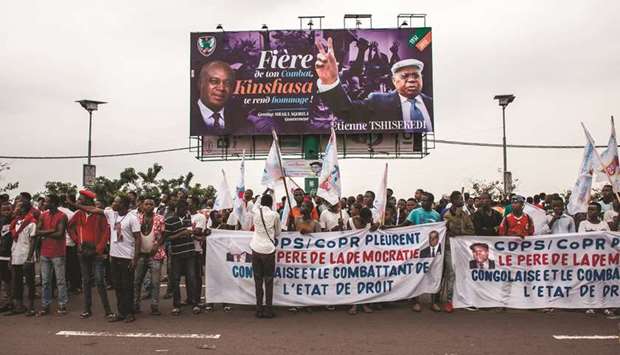
Supporters of late Congolese opposition leader Etienne Tshisekedi wait outside the airport in Kinshasa yesterday.