


Boris Johnson has been summoned to court to face accusations of misconduct in public office over comments made in the run-up to the EU referendum.
The ruling follows a crowdfunded move to launch a private prosecution of the MP, who is the frontrunner in the Tory leadership contest.
Johnson lied and engaged in criminal conduct when he repeatedly claimed during the 2016 EU referendum campaign that the UK sent £350mn a week to Brussels, lawyers for a 29-year-old campaigner, who launched the prosecution bid, told Westminster magistrates court last week.|
A legal team assembled by Marcus Ball, who has accused the former foreign secretary of misconduct in public office and raised more than £200,000 to finance the prosecution, laid out their case in front of the district judge, Margot Coleman.
The case concerned the “now infamous claim” by Johnson about the £350mn, according to Lewis Power QC, who said the case was not about preventing or delaying Brexit.
Coleman ruled yesterday: “The allegations which have been made are unproven accusations and I do not make any findings of fact. Having considered all the relevant factors I am satisfied that this is a proper case to issue the summons as requested for the three offences as drafted. The charges are indictable only.
“This means the proposed defendant will be required to attend this court for a preliminary hearing, and the case will then be sent to the crown court for trial. The charges can only be dealt with in the crown court.”
The next hearing at Westminster magistrates court is expected to take place in three or four weeks and will be purely administrative, but Johnson will have to attend. He and his legal team will be asked if he intends to contest the case.
It would then be sent to a crown court, probably Southwark, where it would be listed for a preliminary hearing. At this point, Johnson’s team would be expected to seek to have the case dismissed.
A full trial, which would take place in front of a jury, would not be expected to take place for another six months, by which time Johnson could be prime minister.
The offence of misconduct in public office carries a maximum sentence of life imprisonment, according to the Crown Prosecution Service website.
Acting for Johnson, Adrian Darbishire QC, told the court last week that the application by Ball had been brought for political purposes and was a “political stunt”.
“Its true purpose is not that it should succeed, but that it should be made at all. And made with as much public fanfare as the prosecution can engender,” he said. “The application represents an attempt, for the first time in English legal history, to employ the criminal law to regulate the content and quality of political debate. That is self-evidently not the function of the criminal law.”
However, in her ruling yesterday, the judge said she was satisfied there was a prima facie case for the allegation that there had been an abuse of the public’s trust in a holder of office.
She referred to statements provided by Ball’s team from members of the public that addressed the impact that “the apparent lie” had had on them. She also cited the contention by Power that “there will seldom be a more serious misconduct allegation against a member of parliament or mayor than to lie repeatedly to the voting public on a national and international platform, in order to win your desired outcome”.
A central plank of the case put forward by Ball’s team was that Johnson, as an MP and previous mayor of London, “lied and misled” the public about the cost of EU membership and used the “platforms and opportunities offered to him by virtue of his public office”.
Coleman’s ruling noted that, as mayor, Johnson signed off several letters in that capacity when expressing his views on Brexit. His then chief of staff, Edward Lister, was also said to have informed the mayor’s staff that it was “official mayoral policy” to support the case for leaving the EU.
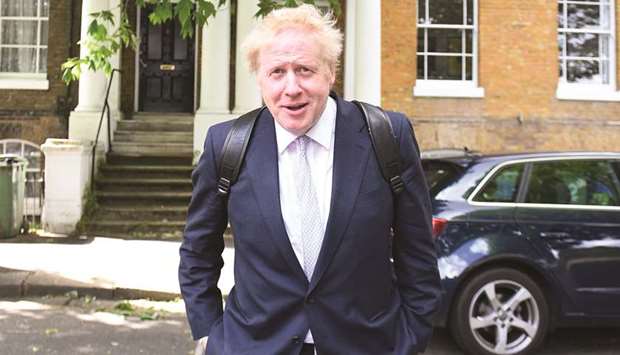
Boris Johnson