


World stock markets and oil prices tumbled yesterday as China reportedly warned it could limit exports of rare metals, used in cameras, computers, smartphones and televisions, in its trade war with the United States.
Troubling movements on bond markets also suggested that economies could be in for a rocky ride, analysts warned.
“Again we see how the market is moving around on US-China news flow that is hard to lock down,” commented Niel Wilson at Markets.com.
“China’s threats to stop rare earth exports are clearly a bargaining chip, if not exactly a trump card, but one the market is starting to really take seriously,” he noted.
Asian equities slid as investors grew anxious about a possible economic slowdown in the absence of progress in resolving the US-China trade spat.
In a sign of intensifying concern over economic growth, the yield, or rate of return for investors, on the 10-year US government bonds hit 2.22%, the lowest level since September 2017.
“As the US 10-year treasuries rally, the yield declines, so much so that it has inverted, falling below the yield curve of the 3-month treasury,” noted Fiona Cincotta, a senior market analyst at Cityindex.
“This is the second time this year that the 10-year and 3-month yield curves have inverted.
Historically, an inversion is considered a warning signal for a recession.
The bond market last sounded this alarm back in 2007,” when the world was on the brink of a financial crisis, she added.
“With investors flocking to US 10-year Treasury bonds on Tuesday night – yields are at a 20-month low – the European markets resumed their fearful performance yesterday,” remarked Spreadex analyst Connor Campbell.
“The catalyst for the latest round of losses was a thinly-veiled threat from China over its willingness to throw around its rare earth weight in its battle with the US.”
A Chinese state media report suggested Beijing would restrict exports of rare earths, using the minerals as leverage in the trade dispute. Rare earths are a key component in electrical devices and any move to restrict their supply would have a devastating impact on manufacturers, with China producing more than 95% of the metals.
“Given that the materials are used in everything from iPhones to missile guidance systems to electric cars... the country may have found its not-so-secret weapon in the trade war,” Campbell added.
Economists agree that a trade dispute between the world’s top two economies has grim implications for consumers, who ultimately bear the costs of punitive tit-for-tat tariffs.
In Europe, London’s FTSE 100 lost 1.2 % to 7,185.30 points, Frankfurt’s DAX 30 was down 1.6% to 11,897.81 and Paris’s CAC 40 slipped 1.7% to 5,222.12 points at close yesterday.
European investors digested the implications of a possible new row between the European Commission and Italian authorities over budget plans that would push Rome’s public deficit above the EU limit.
The Commission said it had asked for “clarifications” on Italy’s 2019 budget, but the country’s far right Deputy Prime Minister Matteo Salvini brushed off the threat.
The yield on 10-year Italian government bonds rose to 2.64%.
On currencies, the dollar index was set for a fourth straight month of gains, benefiting from flows away from markets such as Asia that are considered at greater risk from a trade war.
The euro was unchanged at $.1.117 after falling two straight days. The British pound held at $1.2643.
Commodity markets were also dominated by fears of economic downturn, with Brent crude off almost 2% at $68.79 per barrel. But gold benefited from the safe-haven bid, rising 0.3% to $1.282 an ounce.
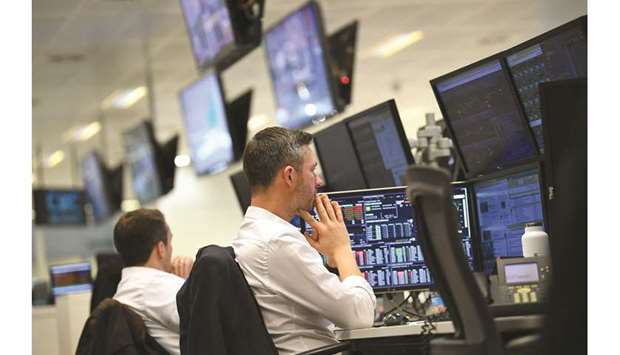
Traders monitor share prices at the London Stock Exchange. The FTSE 100 lost 1.2 % to 7,185.30 points yesterday.