


The US walked out of the Conference on Disarmament yesterday to protest against Venezuela assuming the rotating presidency of the UN-sponsored forum — as it did a year ago when Syria took the chair.
The Trump administration, which has stepped up sanctions against the government of Nicolas Maduro, has not ruled out military action to remove what it and dozens of other nations consider an illegitimate government that rigged a 2018 election.
As Venezuela took up the one-month presidency of the Geneva talks, US disarmament ambassador Robert Wood left the session and announced a “boycott” while Maduro ambassador Jorge Valero chairs it.
“We have to try to do what we can to prevent these types of states from presiding over international bodies,” Wood told reporters.
“Clearly, when you have regimes like the (Bashar) Assad regime (of Syria) and the Maduro regime presiding over this body, there is something fundamentally wrong with how we are conducting our business.
And we need to examine that,” he said.
A representative of Venezuelan opposition leader Juan Guaido, the “interim leader”, should assume the seat, Wood said.
Latin American delegations including Argentina, Brazil and Chile who also recognise Guaido stayed away from the conference. Syria and Russia denounced what they called its politicisation.
Valero condemned the move.
“We regret that the representative of the US and its docile allies continue to bring to this forum matters that are outside the mandate of the CD,” he told a news briefing. “It is not a forum for coup-mongering.”
More than $4.5bn in Venezuelan assets have been frozen or confiscated under US-led sanctions that are crippling vital imports of food and medicines, Valero added.
Maduro, who maintains control over Venezuela’s state institutions calls Guaido a puppet of Washington and blames US sanctions for a hyperinflationary economic meltdown and humanitarian crisis.
Meanwhile, the European Union yesterday named Spanish-Uruguayan former banker and diplomat Enrique Iglesias as its point man to help end the crisis in Venezuela, part of an intensification of diplomatic efforts to seek new elections.
The EU, which leads an international crisis group with South American nations, hopes Iglesias can help find a way to convince Maduro to step aside and allow all political groups in the country to contest a free and fair vote.
Maduro maintains control over Venezuela’s state institutions but the country’s opposition is pushing to remove him amid a catastrophic economic collapse that has created a humanitarian crisis.
Iglesias, a former Uruguayan foreign minister and a former president of the Inter-American Development Bank, is seen by diplomats as having the contacts and know-how to talk to both Maduro and Venezuelan opposition leader Juan Guaido, as well as other political groups.
Having met Maduro and Guaido this month, the EU’s crisis group that includes Britain, France and Germany also hopes to convince the US to back a peaceful diplomatic process out of the crisis.
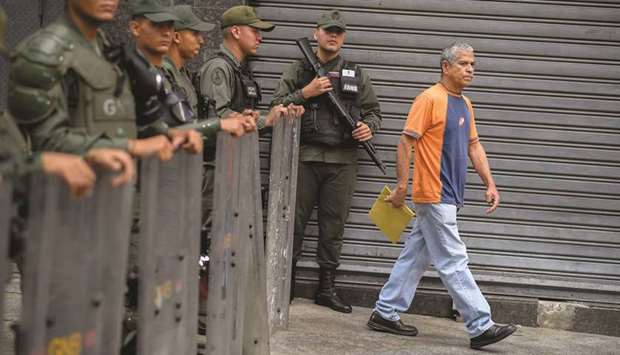
Members of Venezuela’s Bolivarian National Guard block the press’ access to the Federal Legislative Palace, which houses both the opposition-led National Assembly and the pro-government National Constituent Assembly, in Caracas yesterday.