


The pound hit multi-month lows versus the dollar and euro yesterday on renewed prospects of a no-deal Brexit after Britain’s Labour opposition pulled out of key talks with Prime Minister Theresa May.
In the US meanwhile, President Donald Trump confirmed reports he will delay by six months a decision on imposing steep tariffs on imported autos, which limited declines on the equity markets.
The pound unravelled to the lowest point for four months against the dollar, while the euro hit a three-month high versus the British currency.
“The overriding fear for currency traders is that... a hard no-deal Brexit is back on the table,” said Jasper Lawler, head of research at London Capital Group. “Soft Brexit optimism is fading, pulling the pound lower.”
After some sharp declines and recoveries, sterling stands about 10% lower against the dollar and euro compared with just before the UK Brexit referendum in June 2016.
Opposition Labour leader Jeremy Corbyn said he would continue to oppose the government’s Brexit deal although he would “carefully consider any proposals the government wishes to bring forward to break the... deadlock”.
The announcement came after May agreed on Thursday to set out early next month a timetable for her departure as prime minister amid uproar in her own Conservative Party.
MPs have three times rejected the divorce deal she struck with Brussels, weakening her authority and forcing her to reach out to Labour.
Elsewhere, stock markets mostly fell back yesterday as data indicating a strong US economy were offset by the increasingly tense trade and technology stand-off between China and the United States.
The US figures however helped sentiment somewhat after almost two weeks of volatility sparked by US President Donald Trump’s threat, and implementation, of higher tariffs on Chinese imports.
Trump’s move threw a spanner in the works for high-level China-US talks that seemed to be close to conclusion and led to retaliation in kind from Beijing, fanning fears of a painful trade war between the economic titans.
The president has since barred Chinese telecoms firms – effectively taking aim at giant Huawei – from the US market and added it to a list that restricted its access to high-tech US products as well.
OANDA senior market analyst Jeffrey Halley said investors seem “to have temporarily given up trying to predict the fluid situation that is US-China trade relations and concentrate on the here and now”.
Trump’s confirmation that auto tariffs had been delayed boosted car manufacturers.
European stocks closed lower, although London was helped by the weak pound, while on Wall Street the Dow index was treading water in the late New York morning.
London’s FTSE 100 was down 0.1 % at 7,348.62 points, Frankfurt’s DAX 30 lost 0.6 % to 12,238.94 and Paris’s CAC 40 fell 0.2% to 5,438.23 points at close yesterday.
In commodities trading Friday, oil was mixed amid tensions in the Gulf, with crude-rich Iran rejecting negotiations with Washington following the deployment of extra US forces to the region.
Meanwhile, the pound unravelled to the lowest point for four months against the dollar, while the euro hit a three-month high versus the British currency.
“The overriding fear for currency traders is that... a hard no-deal Brexit is back on the table,” said Jasper Lawler, head of research at London Capital Group. “Soft Brexit optimism is fading, pulling the pound lower.”
After some sharp declines and recoveries, sterling stands about 10% lower against the dollar and euro compared with just before the UK Brexit referendum in June 2016.
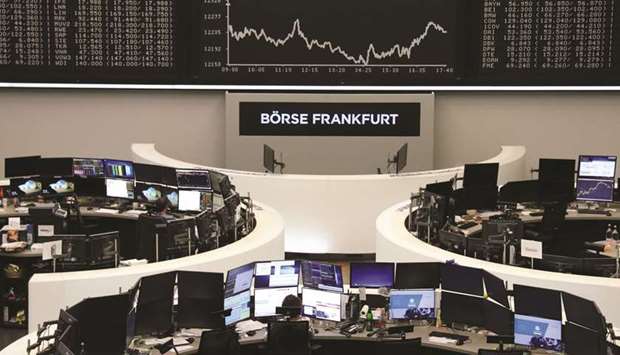
The German share price index DAX graph is seen at the Frankfurt Stock Exchange. The DAX 30 lost 0.6 % to 12,238.94 points yesterday.