


Indonesia’s economy expanded more slowly than expected in the first quarter of this year, as investment dropped ahead of elections and campaign spending failed to sustain growth momentum.
Southeast Asia’s largest economy grew 5.07% in January-March from a year earlier, the slowest pace in a year, data from the statistics bureau showed yesterday. A Reuters poll had expected gross domestic product growth of 5.18%, in line with fourth-quarter expansion.
Alongside soft investment, cooling household consumption, which accounts for more than half of the economy, also contributed to the slowdown, the bureau said.
Analysts had expected campaign spending and logistical preparations ahead of the world’s biggest single-day election on April 17 to cushion weaker investment and exports. President Joko Widodo won a second term in office based on sample counts from private pollsters, though his opponent Prabowo Subianto has also claimed victory.
Official results are due by May 22.
Indonesia’s rupiah showed little reaction to the data, but had slipped ahead of the release on concerns over a fresh deterioration in the US-China trade dispute. The benchmark stock index extended its fall slightly.
“The stimulus from election-related spending was not as strong as we had initially expected,” said Satria Sambijantoro, an economist with Bahana Sekuritas, labelling growth “a relative underachievement” considering the election bump. Still, DBS analyst Masyita Crystallin said growth had held up relatively well given the broader global economic slowdown.
Some economists said Bank Indonesia (BI) was unlikely to immediately respond by cutting interest rates, noting BI had signalled it would wait until the current account deficit narrows.
BI last year raised rates six times by 175 basis points to defend the rupiah, making it one of Asia’s most aggressive central banks amid growing pressure from US interest rate hikes and a ballooning current account gap.
Some analysts have argued BI has room to unwind these hikes to support economic growth this year, as the United States turns more dovish with its monetary policy and Indonesia’s inflation stays near the lower end of BI’s target range. There are also calls for President Widodo to take bolder steps to boost GDP with annual growth falling short of his 7% growth target in his first term, having stalled at around 5%.
“The government needs to provide a policy incentive to improve the investment climate and at the same time support exports,” said Josua Pardede, an economist at Bank Permata.
The government’s growth target for 2019 is 5.3%, while the central bank has forecast a range of 5%-5.4%.
The statistics bureau said election-related spending, which includes events by political parties and promotion materials such as flags and banners, boosted sectors like textile, which saw orders rise in January-March.
Household consumption on items such as food, health and education also remained relatively strong, but the high price of airline tickets slowed spending on travel.
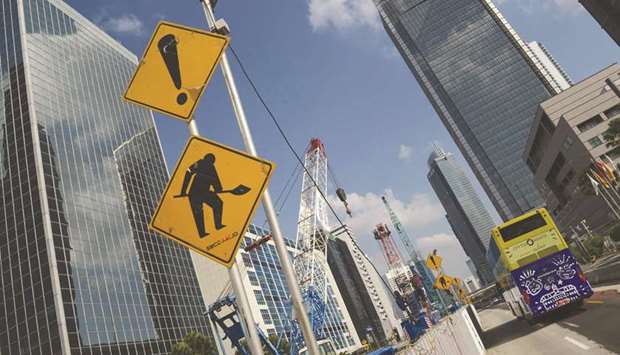
Warning signs are posted on the construction site of Indonesia’s mass rapid transit in Jakarta. Indonesia’s economy grew 5.07% in January-March from a year earlier, the slowest pace in a year, data from the statistics bureau showed yesterday.