


Turkish Central Bank Governor Murat Cetinkaya said yesterday interest rate hikes remained an option if inflation unexpectedly jumps, and he defended the bank’s stable of reserves against concerns that have grown as the lira tumbled in recent weeks.
He also said the bank was leaving its inflation forecasts unchanged at 14.6% for end-2019 and 8.2% next year as he presented the bank’s quarterly inflation report, pledging to use all tools available to boost confidence in the currency.
The assurances received a lukewarm welcome by investors who were looking for more detail on a drop in the net foreign-exchange reserves that could be used to head off another currency crisis, and the lira slipped a bit before recovering.
The lira has dropped another 12% this year due in part to worries that the central bank would tighten policy too soon to sustainably lower annual price rises, which was 19.71% in March, four times higher than target.
Last week, the central bank left its key interest rate unchanged at 24% but in its statement dropped a previous reference to possible further tightening if needed, a dovish shift that hit the lira.
Cetinkaya talked down the significance of the change in the statement’s wording, saying it “reflected a structural approach more than a short-term signal of direction.”
“If upward risks (to inflation) materialise, additional tightening can be provided the moment that the monetary policy committee sees a need on this issue,” he said.
The lira weakened as far as 5.9850 against the dollar during the presentation, its weakest since October 12, but it rebounded partially to 5.9670 afterwards.
Investors are increasingly concerned about inflation, which peaked at a 15-year high above 25% in October in the wake of the crisis that wiped nearly 30% off the lira’s value last year.
Piotr Matys, emerging markets forex strategist at Rabobank, said Cetinkaya’s comments indicate the central bank realized it was a mistake last week to remove its firm commitment to raise rates.
“It’s all confusing. At a time that the central bank’s credibility is not particularly high, policymakers cannot afford to send such confusing signals,” he said.
Yet Cetinkaya said recent fluctuations in the bank’s forex reserves were not abnormal.
He added that it was important to look at medium term trends when looking at reserve levels, and there was no deterioration in any parameter of reserve effectiveness.
Analysts said the governor’s comments did not fully convince markets.
“The statements made were not able to fully remove the markets’ question marks regarding the net reserves,” said Muammer Komurcuoglu, economist at Is Investment.
Turkey’s central bank ramped up its use of swaps to boost overall reserves last month, bank data showed last week.
Cetinkaya said the bank knew the impact of swap transactions on reserves, and that the increase in swap transactions was carried out to support the market in the face of a market anomaly.
He added the bank would decisively use all tools available to bring down inflation in line with targets, forecasting inflation would fall to single digits in the second quarter of 2020.
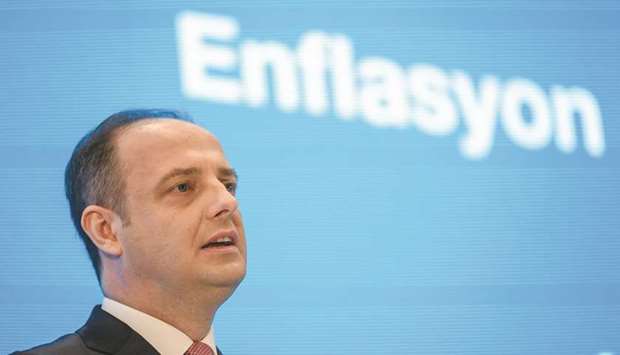
Turkish Central Bank governor Murat Cetinkaya speaks at his press conference in Istanbul yesterday. He defended the bank’s stable of reserves against concerns that have grown as the lira tumbled in recent weeks.