


The phenomenon known as thundersnow announced the arrival of a storm expected to dump more than a half-foot of snow on the US Midwest on Saturday, more than a month into spring.
Midwesterners retrieved their winter wear from storage to trudge through a possible 15cm to 25cm of snow predicted over the weekend in the Chicago area and more than 30cm in some isolated areas of Minnesota, Iowa, southern portions of Wisconsin and northern Illinois, forecasters said.
“It will be heavy at times,” said Meteorologist Andrew Orrison of the National Weather Service’s Weather Prediction Center in College Park, Maryland.
“It is pretty impressive for the end of April across the Midwest to be getting these kind of totals,” he said, attributing the storm to a late-season surge of cold air from Canada.
More than 200 flights in and out of Chicago’s O’Hare International Airport were cancelled or delayed by late morning as the wet weather began rolling across the nation’s midsection.
The heaviest impact in Chicago was expected in the late afternoon yesterday.
“It will start out as rain, then gradually mix with snow, and change over to a heavy wet snow in the late afternoon, especially this evening, across the Chicago metropolitan area,” Orrison said.
By late morning, thundersnow — a thunderstorm that delivers snow rather than rain — and accumulating snow were reported across southeastern South Dakota, southwest Minnesota and northwest Iowa, he said.
“Even some of the bigger cities – including Chicago – may actually see a fairly substantial amount of accumulating snow by the time it ends later tonight,” Orrison said.
Once the storm system dissipates, temperatures were expected to rebound, at least into the 10C to 16C.
After the storm, Midwesterners can look forward to some good news — and some bad news.
“The snow that accumulates will melt fairly rapidly. By Monday, we’ll be near 20C,” Orrison said.
Melting snow in already-flooded parts of the Midwest, however, may not be welcomed by farmers who for months have been facing devastation from ruined crops and drowned livestock.
“That will tend to slow the retreat of floodwaters ongoing across the Midwest,” Orrison said.
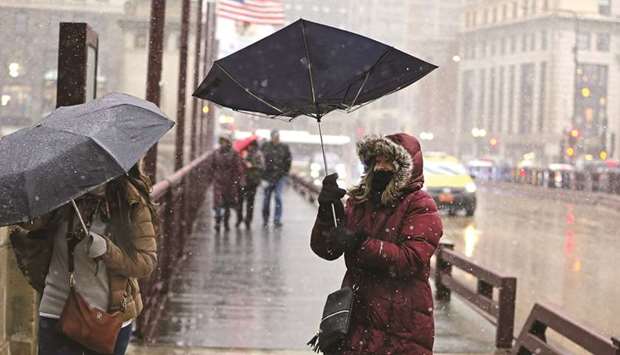
A woman walks on Michigan Avenue in Chicago during a storm on Saturday.