


India’s tycoons are playing a pivotal role in the country’s s most expensive election ever, from funding campaigns and tacit endorsements to being hot-button issues themselves.
Prime Minister Narendra Modi’s re-election bid has received huge financial backing from corporate India, raising fears about the integrity of the world’s largest democratic process, experts say.
Meanwhile, Congress Party president Rahul Gandhi is trying to exploit a fighter jet deal involving industrialist Anil Ambani while fugitive tycoons Vijay Mallya and Nirav Modi loom over the vote from London.
Contesting polls is getting costlier in India and analysts say parties are becoming more reliant on donations from anonymous businessmen, leading to a lack of transparency and worrying conflicts of interest.
“There’s a trend towards plutocracy,” Niranjan Sahoo, of the Observer Research Foundation (ORF) think-tank, told AFP.
“Unbridled corporate influence can have a serious impact on policies,” he added.
The New Delhi-based Centre for Media Studies estimates that around $5bn was spent during the 2014 election that swept Modi’s Bharatiya Janata Party to power - up from $2bn in 2009.
The group thinks the 2019 contest could top $7bn, making it one of the priciest elections globally.
“Elections are getting more expensive for many structural reasons,” Milan Vaishnav, a senior fellow at the Carnegie Endowment for International Peace think-tank, told AFP.
“(There is a) growing population, increasing political competition, voter expectations of handouts in the form of cash and other inducements, and technological change, which means greater outlays for media and digital outreach,” he added.
Analysts say traditional funding streams, such as party memberships, are declining so parties increasingly rely on wealthy donors to fund campaigns.
Data compiled by the Association for Democratic Reforms (ADR), an election watchdog, showed that in financial year 2017-18 corporates and individuals contributed 12 times more to the BJP than to six other national parties, including Congress, combined.
The BJP received 93% of all donations above Rs20,000 ($290) that year, according to ADR’S analysis.
The BJP banked Rs4.37bn ($63.3 mn); Congress got just Rs267mn.
“There is a huge funding disparity now. Congress simply doesn’t have the money to fight elections. That should worry people,” said the ORF’s Sahoo.
Modi’s government says it has cracked down black money in politics by lowering the amount that can be donated in cash from Rs20,000 to Rs2,000.
Critics, however, say it is now easier for wealthy entities to donate to political parties; corporate funding formed 92% of the total donations declared by the BJP in 2017-18, according to ADR.
Detractors point to the government removing a cap on corporate donations two years ago and introducing a scheme whereby donors can give anonymously through “electoral bonds” purchased from a bank.
On Friday the Supreme Court ordered parties to reveal the identity of donors after activists challenged the bond system, which the government has defended.
“The lack of transparency allows conflicts of interest and quid pro quos to flourish”, said Vaishnav, who suspects that medium-sized businesses requiring permits from the government are more of an issue than India’s big oligarchs.
Tycoons do not explicitly endorse candidates for fear of backing the wrong horse but Modi, 68, is seen to be close to several big tycoons.
In 2014 he travelled between rallies in a corporate jet and helicopter owned by billionaire industrialist Gautam Adani, while magnate Ratan Tata praised Modi for carrying out air strikes in Pakistan.
India’s richest man Mukesh Ambani - whose personal net worth has soared from $18.6bn when Modi came to power to $53bn today, according to Forbes - has repeatedly called him “our beloved prime minister” in speeches.
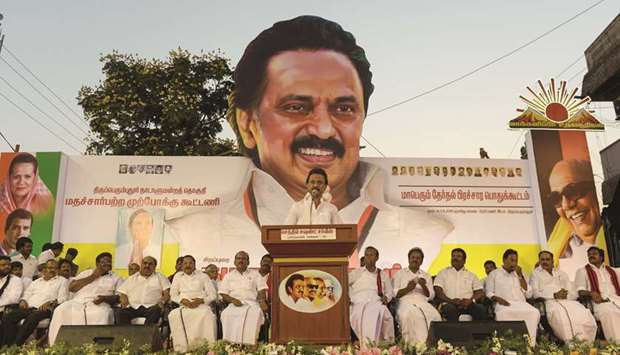
Dravida Munnetra Kazhagam (DMK) party president M K Stalin speaks during an election rally in Sriperumbudur in Tamil Nadu yesterday.