


WikiLeaks founder Julian Assange’s seven-year hideout in Ecuador’s London embassy ended spectacularly yesterday when British police arrested him on an extradition request from the US to face hacking charges.
Footage shot by the Russian video news agency Ruptly showed a frantic-looking Assange — his worn face framed by a bushy white beard and shock of silver hair — being hustled out of the building by burly men in suits and pulled into one of two waiting police vans.
A Ruptly reporter who shot the scene and requested anonymity said Assange shouted “UK must resist” as he was hauled away by at least seven men dressed in dark suits and ties.
The scene took place on a plush side street in the heart of London that has been Assange’s refuge from prosecution since 2012.
“No one is above the law,” Prime Minister Theresa May said to a round of cheers in parliament.
The moment of high drama came after Ecuador, which has grown increasingly frustrated with Assange’s stay under pro-US President Lenin Moreno, withdrew its asylum.
Police said Assange had been initially arrested for breaching his bail conditions in 2012 and then “further arrested on behalf of the US authorities”.
Within hours, pony-tailed Assange appeared in court for a brief hearing where he gave a thumbs-up sign to the press gallery and sat reading a copy of Gore Vidal’s book History of the National Security State about the US military-industrial complex, before the hearing began.
Judge Emma Arbuthnot pronounced Assange guilty of the bail charge, which carries a sentence of up to a year in prison, and remanded him in custody to face sentencing at an unspecified later date.
He also faces a separate hearing on the US extradition request on May 2.
Assange had long suspected that he was secretly wanted by Washington for his decision to publish a trove of classified Pentagon documents detailing alleged US war crimes in Afghanistan and Iraq.
US authorities had steadfastly refused to confirm reports that they had issued a sealed indictment against Assange — until yesterday.
The US justice department said Assange was being charged with a computer hacking conspiracy relating to his work with former US intelligence analyst Chelsea Manning in March 2010.
“Assange is charged with conspiracy to commit computer intrusion and is presumed innocent unless and until proven guilty beyond a reasonable doubt,” a US justice department statement said.
“If convicted, he faces a maximum penalty of five years in prison.”
Assange will now be at the heart of a legal and diplomatic tug of war pitting him and his legions of supporters — including Russian authorities — against the US justice system.
His US-based attorney Barry Pollack condemned “an unprecedented effort by the US seeking to extradite a foreign journalist to face criminal charges for publishing truthful information”. WikiLeaks accused Ecuador of breaching international law by withdrawing his asylum.
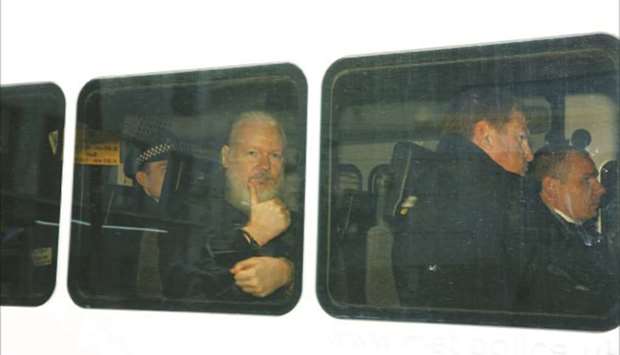
WikiLeaks founder Julian Assange flashes a thumbs-up from a police van, after he was arrested by police, in London yesterday.