


Algeria will hold a presidential election on July 4, the interim presidency said yesterday after weeks of mass protests led to the resignation of long-serving leader Abdelaziz Bouteflika.
No further details were immediately given.
On Tuesday, interim president Abdelkader Bensalah had said he would organise free elections within 90 days.
Earlier yesterday, Algeria’s army chief said he expected to see members of the ruling elite in the major oil and natural gas-producing country prosecuted for corruption and that he would support a transition towards elections.
Lieutenant General Gaid Salah’s comments were the strongest hint yet that the military would play its traditional role as kingmaker after the ailing 82-year-old Bouteflika bowed to popular pressure and quit on April 2 after 20 years in power.
“The army will meet the people’s demands,” said Salah, addressing officers and soldiers at a military base.”The judiciary has recovered its prerogative and can work freely.”
He referred to the ruling caste as “the gang”, a term people have used in the protests to describe Bouteflika’s inner circle, which encompassed retired intelligence officials, oligarchs, members of the ruling National Liberation Front (FLN) and some veterans of the 1954-62 war of independence against France.
The army chief of staff urged the judiciary to reopen a corruption case against oil and gas giant Sonatrach, an object of resentment for many Algerians who accuse their leaders of stealing the North African nation’s wealth. More than one in four people under the age of 30, some 70% of the population, are unemployed — one of the central grievances of protesters who want the economy liberalised and diversified to reduce its reliance on energy.
In 2012, a series of scandals shook Sonatrach, which was tightly controlled by Bouteflika loyalists. Its CEO and other executives were imprisoned for graft offences.
The army patiently monitored the unrest, which started on Feb 22, from the sidelines.
Then Salah intervened, declaring Bouteflika — rarely seen in public since suffering a stroke in 2013 — unfit to rule.
If Bouteflika had seen through his original plan to run for a fifth term despite growing grassroots opposition, that would have put the military under pressure to restore order, instead of focusing on swaying politics from the shadows.“It is unreasonable to manage the transition period without institutions that organise and oversee this operation,” said Salah, lending support to interim leaders.
Algeria’s generals are highly sensitive to instability.
In the early 1990s, the army cancelled an election that conservatives were poised to win, touching off a shattering civil war that killed an estimated 200,000 people.
“The army is pushing hard to get the protesters to back its plan to hold elections in 90 days, keeping the transition within the constitution framework,” independent analyst Ferrahi Farid said before the announcement of the election date. The military has faced little resistance from protesters; rather, their fury has been directed at what is popularly described as the fortress — an FLN-associated old guard that has been entrenched for decades.
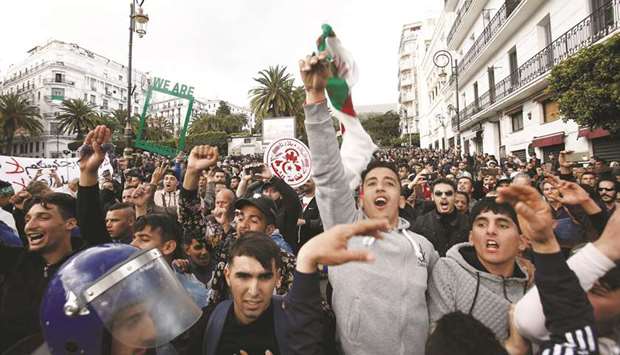
People protest against the appointment of interim president Abdelkader Bensalah and demanding radical changes to the political system in Algiers, yesterday.