


At an election rally in the eastern state of West Bengal, a local leader from Prime Minister Narendra Modi’s Bharatiya Janata Party (BJP) described how workers from the state’s ruling Trinamool Congress (TMC) had disrupted a public meeting in January by destroying their vehicles.
“So, we thrashed them in retaliation, smashed their vehicles and burnt their party office,” Arup Das, a district secretary of the BJP, roared at the rally in the town of Kharagpur.
“Stand up and protest,” Das said to the crowd. “Trinamool Congress will run away in fear.”
Political differences have been erupting into tension and sometimes violence across India ahead of the general election in April-May, but it’s particularly bad in West Bengal.
Both the BJP and the TMC are accusing each other of killings, beatings, vandalism and making false allegations to the police.
After losing three state elections late last year, and with weak farm incomes and slow jobs growth undermining his backing in the BJP’s traditional Hindu base in the north, Modi is driving hard to pick up support in West Bengal.
The push has set him and the BJP on a collision course with firebrand TMC leader and Chief Minister Mamata Banerjee.
For Banerjee, popularly called ‘Didi’ or elder sister, defeating the BJP’s challenge is vital to cement her power base and bolster her image as a possible future prime minister if opposition parties win enough seats to form a coalition government.
“BJP is rising in West Bengal,” said Udayan Bandyopadhyay, head of the political science department at Bangabasi College in Kolkata.
There is a sense of anti-incumbency that is working against Banerjee, who has won the previous two state assembly elections, Bandyopadhyay said.
BJP did well at village council polls last year and a recent survey showed the party winning eight out of the 42 parliamentary seats in Bengal, up from two currently.
To be sure, Modi could win the national election without taking many seats in West Bengal.
What could have been a close contest has changed in recent weeks because of a suicide car bomb attack in Kashmir that killed 44 paramilitary troopers.
That led to an Indian warplane attack on what the Indian government said was a “terrorist” training camp in Pakistan, and subsequent retaliation by the Pakistanis.
Pollsters say they expect Modi to get a boost because of the sense of nationalism stirred by the events in Kashmir.
And the disarray among parties opposed to the BJP will also play in its favour.
The BJP has been holding a series of mega rallies in West Bengal headlined by top BJP leaders, including Modi himself.
Rather than emphasising its national agenda, such as driving economic growth and providing affordable housing, the BJP in West Bengal has been focusing more on accusing TMC of corruption and Banerjee of running a dictatorship.
The BJP said it had to cancel several visits by senior leaders to address rallies as Banerjee’s administration denied permission for their helicopters to land.
The BJP’s West Bengal president Dilip Ghosh said police and other government officials were being used by Banerjee to thwart democracy in the state.
“I’ve announced openly everyone should carry batons, bamboos and if goons attack you, you hit back. So we are fighting back. Now goons are afraid to turn up,” said Ghosh.
On Saturday, Congress president Rahul Gandhi, also accused the TMC of regularly harassing and beating up its workers in West Bengal.
Still, it will be an uphill task to defeat 64-year-old Banerjee, an aggressive and strong-headed politician with grassroots appeal.
Posters of Banerjee in a quintessential Bengali lower middle-class cotton sari and rubber flip flops are seen across the state.
In January, she brought together more than 20 regional parties, including the Congress, on one stage in Kolkata, under the ‘United India’ banner.
It was a show of opposition to the BJP that drew hundreds of thousands from rural Bengal.
Banerjee has announced government subsidies and incentive schemes aimed at benefiting the poor.
But critics say she is attracting voters by funding local clubs and organising events, such as mass marriages, where gifts can be made.
Hindu groups linked to the BJP also accuse her of appeasing Muslim voters, who make up about one-third of the electorate, by providing separate schools, hospitals and training institutes for the community and handing out stipends.
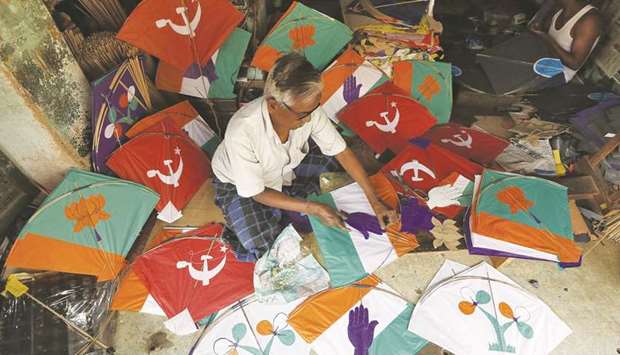
A kite-maker prepares kites with election symbols of political parties at his shop in Kolkata yesterday.