


The arrival of spring season reminds me about spring rolls. The only drawback of Chinese spring rolls is that they are deep fried. So, let’s make something which comes with all the goodness of spring rolls but is not deep fried. Isn’t that exciting – lets learn and explore about this wonderful dish today. These spring rolls are from Vietnam, the elongated skinny country about the size of Italy, with China to the north, Laos and Cambodia to the west and the South China Sea to the east. The food in the north is influenced by China with its stir-fried noodles-based soups. As you move to the south, there is more flavour similarity with nearby Thailand and Cambodia. The tropical climate down south also sustains more rice paddies, coconut groves, jackfruit trees and herb gardens. The southern cuisine in Vietnam is typically sweeter – sweeter broths for pho – more palm sugar used in almost all the dishes.
Vietnam’s food is the most fascinating part about its culture. It is complex, dynamic and often surprising – but believes me – it is never boring. I have seen a lot of Chinese restaurants in hotels convert to Vietnamese restaurants. To consolidate Vietnamese cuisine is a careful balance of five elements and flavours – sweet, sour, salty, bitter and hot. This sensational synthesis makes every meal an interesting and memorable experience. Travel around Vietnam and you’ll notice two universal themes rice and fish sauce. Vietnam is the second largest exporter of rice in the world after Thailand. Rice is served at breakfast, lunch, snacks, dinner and as a dessert too. Rice is used to make food items like rice noodles, rice paper sheets, rice porridge, sticky rice, fried rice, puffed rice snacks and many more. Rice is so significant part of Vietnam culture that they say “com muoi” meaning “rice and salt” when someone sneezes. They believe in saying rice and salt instead of blessing them with good health.
Vietnamese food is also influenced by French cuisine due to their colonisation. The French people had a lasting effect on the country, the people, the architecture, the land and the flavours. Pho is an example of French people leaving their mark – the soup is a blend of Vietnamese rice noodles and French inspired meat broths. One theory even states that pho is a phonetic imitation of the French word “feu” meaning “fire”.
One unique and common aspect of all South East Asia cuisine is the freshness of the ingredients. So much emphasis is given to the freshness of the ingredients and Vietnamese food makes extensive use of fresh herbs, spices and aromatics. Sometimes they go into a steamy pot of pho, sometimes wrapped into spring rolls, sometimes enclosed in a pancake or just stir fried and served hot. Usually the fresh produce is brought daily from the farmers markets and then prepared and served. Some of the commonly used herbs and spices are cilantro, mint, fish mint, basil, lime leaf, lemongrass, green onion, scallion, perilla leaf, turmeric, dill, garlic chives, ginger and galangal, Saigon cinnamon, tamarind pulp.
Majority of the salt required in a dish comes from the fish sauce. Salty, fermented fish sauce is used in marinades, soup broths, salad dressings, spring roll dips and it’s hard to think of any dish where it is not used. The national condiment in Vietnam is “nuoc cham”, which is made with splash of lime juice, sugar, chilies and garlic. Milk is not used in Vietnam and sweetened condensed milk is used in coffee.
Interestingly unripe fruits are also used as vegetables in Vietnam. A green papaya or banana flower for example becomes the base for salads in lieu of the leafy greens. The unripe fruits are also paired with fish sauce, chili, garlic, dried shrimp and chopped peanuts.
Vietnamese spring rolls
Ingredients
Rice paper sheets 8-10 nos.
Shrimp steamed (26-30) 250gm
Lettuce leaves, stem removed 8-10 nos.
Thin Rice noodles 50gm
Carrot shredded 1 no.
Cucumber shredded 1 no.
Tofu extra firm shredded 200gm
Mung bean sprouts ½ cup
Mint leaves 50gm
Cilantro leaves 1 bunch
Nuoc cham for dipping sauce
For nuoc cham
Garlic 3 cloves
Sugar 2 tbsp
Fish sauce 3 tbsp
Rice vinegar 2 tbsp
Lime juice 2 tbsp
Serrano chilli sliced 1 no.
Carrot grated 1 tbsp
Daikon grated 1 tbsp
Method
To make the spring rolls fill a large bowl with hot water, in a separate bowl soak the rice noodles in warm water for 15 minutes.
Steam the cleaned and deveined shrimps for 5-6 minutes or until completely pink in salted water and refresh in cold water and keep aside.
Working with 1 rice paper at a time, dip the round in warm water for only 1 second and lay it on a flat work surface.
To assemble each roll, place several strands of noodles, 1 teaspoon each of the carrot and cucumber, 2 slices of tofu, 1 tbsp of bean sprouts and several leaves of mint, cilantro and 2-3 shrimps.
Be careful about not to overstuff the rolls, lift the bottom edge of the rice paper and carefully place over the noodles and other ingredients, then roll once to form a tight firm cylindrical roll.
Fold in the sides of the rice paper an continue to roll the rice paper and filling for a cylindrical roll.
Place the prepared spring rolls seam side down, on a platter and cover with damp kitchen towel to keep them moist.
For the nuoc cham, grind garlic and sugar in mortar and pestle to form a paste or use a blender if making in large quantity.
Transfer to a bowl and whisk in the fish sauce, rice vinegar, lime juice, and ¼ cup water.
Pour through a fine mesh sieve into a clean bowl and add the chili, carrot and daikon and keep aside.
Cut the roll into two before serving with the prepared nuoc cham.
Note: To make a vegan version of the spring roll use the vegan fish sauce made with seaweed instead. Also replace the shrimp with vegetable like asparagus or artichoke to make a vegetarian/vegan version.
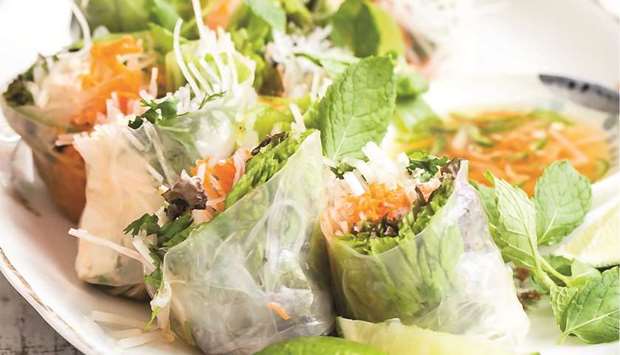
MAJOR ATTRACTION: Vietnam’s food is the most fascinating part about its culture. Photo by the author