


Falconry is an integral part of the heritage and culture of Qatar and other countries in the region, with falconers forming a very special bond with their falcons.
Different expatriate communities living in Qatar have been showing an increasing interest in learning more and more about the history, culture, and traditions of Qatari people. Falconry is one such practice that the expatriates take keen interest in while learning more about the old Arab tradition.
In this regard, Qatar Natural History Group (QNHG) organised a talk on the topic of ‘Falconry in Qatar’ at Doha English Speaking School recently. Speaker Zayed al-Ali, Secretary of ALGannas Falconry Society, gave the presentation to the members of QNHG and other attendees about the history, evolution and current scenes of falconry.
The presentation further discussed differences between wild and domestic breeds of falcon practices of the past and the present and the changes that has brought to the Qatari society.
Zayed was born in Qatar in 1956, to a traditional, nomadic family, which instilled in him the importance of education. He obtained his degree in Economics and Business Administration from the University of Portland, Oregon in USA. In Qatar, he has worked in oil and gas sector. He is a passionate falconer. He is heavily involved in all aspects of falconry happening in Qatar and abroad. Furthermore, al-Ali is an environmental steward, participating and volunteering in conservation efforts led by the Ministry of the Municipality and Environment and other organisations.
Talking to Community, Zayed said: “The presentation was for the people living in Qatar dealing with ecology and history. The history demands young people to talk about the old falconry and the new falconry. The presentation was about how our ancestors and grandfathers used to hunt and why they had to hunt.
“We also talked about the current times and about ALGannas Society where they are using the same old techniques but with a different process through festivals, competitions and organised hunting. There is a big gap between the past and the current situation. We are trying to satisfy and keep the same principal of hunting with falcons in Arabia, the same way it was done 1,000 years ago. That is why ALGannas festivals are the top ones in the world.”
Regarding how such kind of activities help in spreading more awareness about falconry, he said: “This group of people is dealing with Unesco. We at AlGannas are already working with Unesco. We get a good opportunity to share our old traditions that we try to keep it alive for our future generations.”
Explaining the difference between the falconry in the past and today, he said: “There is a big difference. In the past, they used to hunt for food and survival. That was the main purpose. In summer times, they used to release the birds when they did not need them. Now a days, they are using it for keeping the tradition alive and conveying the tradition to the younger generations.”
When asked to share his experience with falconry, he said: “I would say that I was born with it. Most of the Qataris are the same. I came from a nomad tribe. They used to hunt in winter and do pearl diving in summer. I grew up with falconry.
I with AlGannas have been delivering talks on falconry at different places in Qatar. I shared my knowledge of falconry with the audience here and explained how it all works in Qatar and in other parts of the world.”
Esther Bergareche Auricenea, a Spanish designer engineer, was present in the school auditorium to attend the talk. She said: “I have been in Qatar for four years. I attend QNHG talks regularly. They offer very interesting talks for the expatriates. This one is very exciting. I always loved falcons. I have been attracted to the bird. This was a chance to know more about them.
“I have been curious about falcons since I was very young. I want to learn more about such a powerful bird coming to your arms. I learnt how they handle them. Since I am in Qatar, I have also been visiting falcon souq. I always attend different exhibitions related to falcons.
Bajoo Vyaas, Indian doctor working in Qatar, said: “I am interested in photography and environment. That is why I am a part of QNHG. I have been interested in knowing more about falcons. I do not have much knowledge or contact with bird. It was an opportunity to know more about the bird that the Qataris love.”
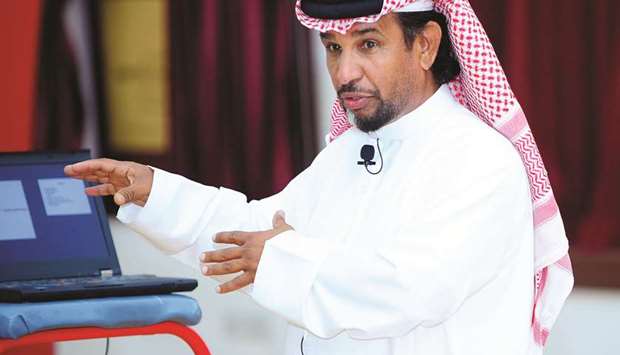
SPEAKER: Zayed al-Ali, Secretary of ALGannas Falconry Society, during a presentation about the history, evolution and current scenes of falconry. Photos by Ram Chand