


For starters, the pair mined the ’90s setting for a bounty of nostalgic needle-drops — enough to make those who recognise them feel downright ancient — from the painstakingly replicated Blockbuster video store that Larson’s titular outer space hero crash-lands into in Los Angeles circa 1995, to the Game Boys and grunge music she encounters wandering the ’90s MCU like a super-powered alien fish out of water.
They auditioned several cat actors before casting an uncannily expressive four-legged thespian named Reggie as Goose, the scene-stealing furry feline companion to future S.H.I.E.L.D. boss Nick Fury (Samuel L Jackson sporting a digital facelift, de-aged 30 years to suit the Avengers prequel timeline).
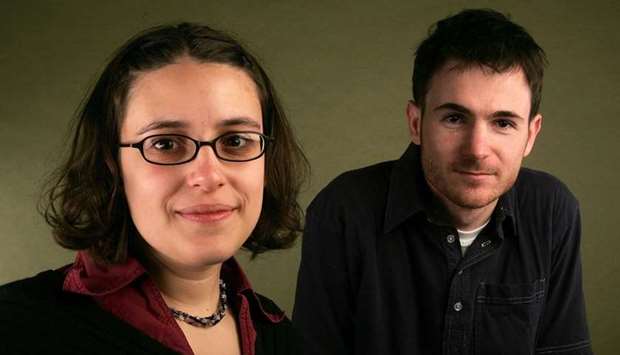
“We just knew,” Boden joked, seated next to Fleck in a Beverly Hills hotel during a recent press stop, of the pivotal moment they cast their Goose. “He had star power.”
Three other orange tabbies who share the role with soon-to-be fan favourite Reggie, she said, were more like “stunt doubles.” “There should have been an arbitration for credit on that,” Fleck said.
But it was the relatable and feminist qualities of Captain Marvel’s journey that initially hooked the writer-directors on the story of Carol Danvers, a character with ties to the Avengers canon who made her comic-book debut in 1968.
Captain Marvel, written by Boden, Fleck and Geneva Robertson-Dworet (who also share “story by” credits with Nicole Perlman and Meg LeFauve), takes its cues from Kelly Sue DeConnick’s celebrated 2012 Marvel Comics run, which reintroduced the character as an Air Force fighter pilot who becomes Captain Marvel.
Unlike many of her predecessors in the MCU with introductory origin stories, Danvers, played by Larson (who segues effortlessly from indies such as Room to franchise fare such as Kong: Skull Island), arrives on the big screen already a super-being.
When the film opens — in space! — she boasts the ability to shoot powerful energy blasts from her fists, and is more than happy to make use of them as a soldier caught in a war between the militaristic alien Kree and their shape-shifting enemies, the Skrulls.
Rather than discovering powers she could never have imagined, Danvers instead has to rediscover what makes her human.
Returning to an Earth she doesn’t remember, she lands on the radar of government agent Fury, faces off with the Skrull leader Talos (Ben Mendelsohn) and reconnects with erstwhile BFF Maria Rambeau (Lashana Lynch), a friendship Larson calls the film’s real love story.
Captain Marvel is, notably, a film in which a woman overcoming her harshest, and primarily male, critics — the ones who have said her entire life that she’s too emotional and can’t possibly make it on her own — is key to her self-actualisation.
“That’s something that was really meaningful for me,” Boden said, “because when you’re doing something that you really care about and you put all you have into it, you experience a lot of emotions: self-doubt, fear, all of these things. It was so lovely to be making a movie about a character who learns to embrace all that.”
Captain Marvel is, not insignificantly, the first in the Marvel Cinematic Universe’s 11-year reign to centre on a female superhero. And with Captain Marvel, Boden is the first woman to direct a Marvel movie.
Marvel Studios head and Oscar-nominated Black Panther producer Kevin Feige, who also produced Captain Marvel, says that inclusion has been a very long time coming to the MCU — both on-screen, in the form of the heroes who get to carry their own movies, and behind the camera.
“I really do think that the talent was always there, but the talent wasn’t always, to be honest with you, on the lists that we were going through,” said Feige, speaking by phone days before the 91st Academy Awards, where Black Panther was nominated for best picture — another first for the company and a rarity for the genre.
“That has completely changed today. Not only because, with Captain Marvel, we said, ‘We must hire a woman to direct it’ internally, but also because the entire world has changed. And there will be many more announcements to come. Put it this way,” he said enigmatically: “It’s only the beginning.”
According to Feige, Marvel will continue to look to hire inclusively, adding that it “also makes for better movies.”
“People have asked me, ‘There’s a lot of diversity in front of and behind the camera — was that a one-off, or will you continue that?’ Well, of course we’re going to continue that,” he said, “because that is the shape of the world, the representation of the world, and that’s what we want up on our screens.”
Captain Marvel, which opens on Friday, is a major step toward that future, a stand-alone spotlight for a new female character who fans already anticipate will figure prominently in April’s epic superhero mash-up Avengers: Endgame.
It’s also a huge leap in scale for Boden and Fleck from the smaller-budget movies and television shows they’ve written or directed together since establishing their partnership over a dozen years ago.
In 2006, their debut film, Half Nelson (which they co-wrote and Fleck directed), propelled then-breakout star Ryan Gosling to an Academy Award nomination. They co-wrote and co-directed the 2008 baseball drama Sugar, casting then-unknown Algenis Perez Soto, who also appears in Captain Marvel, in the tale of a Dominican ball player recruited to play in the US.
Quirky teen rom-com It’s Kind of a Funny Story followed in 2010 — it remains their highest-grossing film at just over $6 million domestic. Then came 2015’s gambling drama Mississippi Grind, starring Mendelsohn, whom they cast in Captain Marvel.
By the time they had their first meetings with Marvel, Boden and Fleck were known exclusively for small-scale, intimate, character-driven movies — not exactly the typical blockbuster helmers in line to direct a big-budget superhero adventure.
It was during a meeting with Feige that the creative intention of Captain Marvel came into focus, Fleck said. “We were banging our heads against the wall and we had all the comic-book art on the wall and Kevin gets up and he points to one particular image of a little girl in a Captain Marvel costume flying, with a ginormous smile on her face. He says, ‘This is what we need this movie to be.’”
“I don’t think we came into it feeling like it needed to be for little girls,” he said. “I don’t think that was the ultimate goal at the beginning. But from that moment on, it became clear that, ‘Yes, that is important, and this movie needs to be for that girl.’”
—Los Angeles Times/TNS
15 facts about Captain Marvel
• Captain Marvel’s human name is Carol Danvers.
• Carol Danvers was a former US Air Force fighter pilot.
• A film based on Carol Danvers was in the works at Marvel Studios since as early as May 2013 and finally we will be able to see it on March 8.
• According to comic books, Captain Marvel was involved in an accident and her DNA was fused with Mar-Vell’s during an explosion, giving her superhuman powers.
• Danvers possesses superhuman strength and durability, can fly at roughly six times the speed of sound, retains her sixth sense, and can discharge explosive blasts of radiant energy, which she fires from her fingertips.
She also demonstrates the ability to absorb other forms of energy, such as electricity, to further magnify her strength and energy projection, up to the force of an exploding nuclear weapon.
• Brie Larson is going to portray Captain Marvel in the upcoming movie.
• Captain Marvel made a first appearance as Carol Danvers in Marvel Super-Heroes #13.
• Carol Danvers was created by Roy Thomas and Gene Colan and Ms. Marvel was created by Gerry Conway and John Buscema.
• Carol Danvers has been labeled “Marvel’s biggest female hero” and “quite possibly Marvel’s mightiest Avenger”.
• She was ranked #11 on IGN’s Top 50 Avengers, and twenty-ninth in Comics Buyer’s Guide’s 100 Sexiest Women in Comics list.
• She had her own series in the late 1970s.
• She has also been known as Binary and Warbird.
• The original Marvel comics Captain Marvel was a male Kree and he was created by Stan Lee. Carol got her powers after the explosion.
• She has worked with a lot of superhero organisations such as The Avengers and the S.H.I.E.L.D.
• Even if we didn’t she her on the movie, Captain Marvel was an integral part of Marvel’s Civil War and she was on team Iron Man.