


The International Trade Secretary, Liam Fox, has said a delay in exiting the EU may be the only way to ensure a smooth departure, as hard Brexiters laid down three tests for Eurosceptic MPs to support Theresa May’s deal.
Fox said it would be “very unfortunate” if MPs were to reject May’s deal and then vote to extend Article 50, in votes the prime minister has promised will take place by March 14.
“But, if we have no option, in order to deliver a smooth Brexit, then so be it,” Fox told BBC One’s The Andrew Marr Show.
May has pledged a vote will take place on her Brexit deal, including any changes agreed in Brussels, by March 12, though it is possible Downing Street will seek to put the vote to MPs as early as next week if changes can be secured. The EU has suggested progress has been minimal.
The European Research Group, a group of Tory Eurosceptics led by Jacob Rees-Mogg, has agreed that a group of eight lawyers, seven of them MPs, will scrutinise and pass judgment on the final compromise offered by the attorney general, Geoffrey Cox.
The group will be chaired by the veteran Eurosceptic Sir Bill Cash and includes the DUP’s Nigel Dodds, whose opinion carries huge weight with Tory Brexiters.
Others in the group include the former Brexit secretary Dominic Raab, former department for exiting the European Union ministers David Jones and Suella Braverman and the backbenchers Michael Tomlinson and Robert Courts, both former barristers, as well as Martin Howe QC, chair of the pro-Leave group Lawyers for Britain.
Tomlinson told the Sunday Times that the committee would apply three tests to whatever Cox produced from the negotiations in Brussels, which if met would deliver the support of the group’s key backers, including Rees-Mogg and former Brexit minister Steve Baker.
Tomlinson said the change “has got to be legally binding, so effectively treaty-level change” and that the attorney general must secure changes that altered his legal advice that the backstop could “endure indefinitely”.
The third requirement is “a clear exit route” such as an end date or a unilateral exit mechanism for the UK to leave the backstop. It remains very unlikely that Brussels is willing to offer anything close to that demand.
“There is a spectrum and a range of options that the attorney general has, but I’m not going to say protocol good, codicil bad, letter very bad, because that would be prejudging it,” Tomlinson said.
May’s hopes of passing her deal were given a boost by Sir Graham Brady, who chairs the 1922 Committee and who has previously successfully championed a Commons amendment that instructed May to return to Brussels to negotiate the complete removal of the backstop from the withdrawal agreement and find another way to solve the Irish border issue.
Now Brady has indicated he could be prepared to drop his demand on the condition that the attorney general wins assurances that the backstop will be temporary.
Brady told the Observer that his intention had always been to “ensure that the backstop could not assume a permanent status, trapping the UK in the EU customs union”.
“As long as the attorney general is able to assure the house that he has a legally binding guarantee that the backstop can only be temporary, I would accept that and would urge others to accept it,” he said.
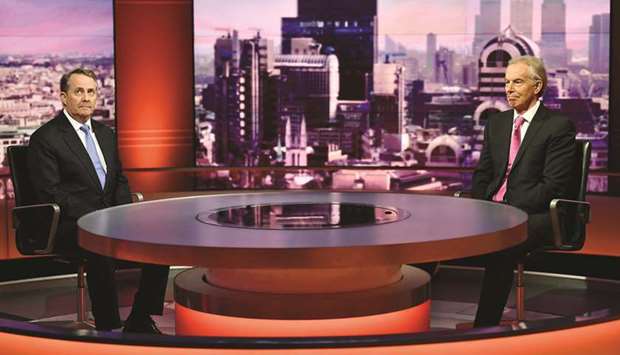
Secretary of State for International Trade Liam Fox and former prime minister Tony Blair appear on BBC TV’s The Andrew Marr Show in London yesterday.