


Rio Tinto Group pledged to keep rewarding investors and to pour more funds into growth projects, including a much-watched copper discovery in Australia’s Outback, after full-year profits rose to beat estimates.
The world’s No 2 miner announced record cash returns of $13.5bn, including a $4bn special dividend, when outlining its results on Wednesday. Rio also offered a first glimpse of the Winu copper project, confirming some early exploration success at the site in Western Australia.
“There can be a lot of payback to shareholders – we don’t need to de-lever our balance sheet anymore,” chief financial officer Jakob Stausholm said in a phone interview. “We are running our investments in a controlled manner, and you can see that we are ramping up.” Capital expenditure jumped 21% in 2018 amid spending on robot trains to bauxite mines, and will rise again in 2020 after holding steady this year, while the balance sheet swung to a net cash position of $255mn.
Still, Rio flagged potential further delays to the $5.3bn expansion of the Oyu Tolgoi copper mine in Mongolia - and Stausholm acknowledged there’ll be no repeat in 2019 of a $8.6bn programme of asset sales this year that helped to bolster shareholder rewards.
“Investors could question if returns could improve from here,” and delays or higher costs in Mongolia could be a slight negative, Goldman Sachs Group Inc analysts including Eugene King said in a note.
Rivals and investors have been clamouring for months for an update on Rio’s hush-hush copper discovery in Australia after work to construct an airstrip and accommodation camp stoked expectations. Competitors had been using satellite images of the project to get an early indication of the size and scale of the discovery.
“What is absolutely clear is there is lots of copper, gold, silver,” Chief Executive Officer Jean-Sebastien Jacques said on a call on Wednesday. High-quality exploration targets are emerging at the discovery, the miner said in a presentation.
A second phase of drilling is underway and while results are encouraging, the project is still at an early stage, Rio said. Early results appear “phenomenal,” Paul Howard, a Perth- based resources analyst at Hartleys Ltd, and former geologist, said by phone. “The size of that would appear to be something quite large.”
Securing a pipeline of projects in metals like copper will be key to helping Rio reduce its dependence on iron ore, which accounts for the bulk of total profits, raising concern about the company’s vulnerability to a slowdown in steel demand growth in China.
While the group’s underlying earnings rose 2% from a year earlier to $8.8bn last year, beating estimates, profits from its iron ore business shrank by 3%. Rio, the second-biggest iron ore exporter, can’t make quick moves to boost capacity as rival Vale SA suffers disruptions, but will continue to look at options, chief commercial officer Simon Trott told reporters on a call.
Copper is a key growth focus for the biggest miners amid forecasts rising demand and faltering production from older mines will leader to a deficit early next decade. The rise of renewable energy and electrification of the transport sector will also bolster demand over the longer-term. Electric vehicles need as much as six times more copper than internal combustion engine cars, according to Rio.
There’s been a revival in spending on metals exploration after global budgets hit a low of about $9bn in 2016, according to Melbourne-based MinEx Consulting. Depending on the location and type of deposit, it can take about an average of 15 years for a copper discovery to be converted into a working mine. Rio’s last two major copper finds, in 2002 and 2005, are yet to become producing operations.
Rio follows top competitors including BHP Group, Vale SA and Anglo American Plc in outlining recent discoveries in the search for more copper. BHP in November identified a possible system about 40 miles southeast of its giant Olympic Dam operation in South Australia. Vale has offered investors early details on the Hu’u project in Indonesia and Anglo is working on a 19,000-square kilometre package of land in Brazil.
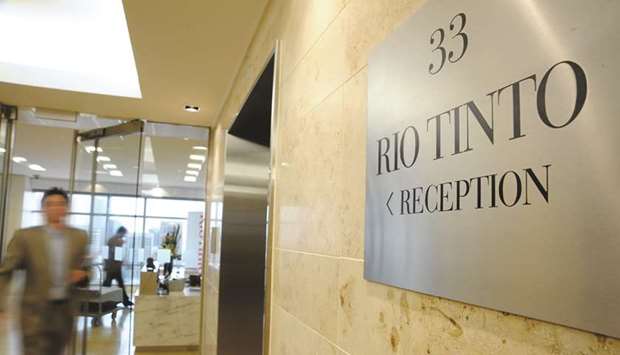
A man walks through the entrance from the reception area of Rio Tinto’s head office in Melbourne. Rio pledged to keep rewarding investors and to pour more funds into growth projects, including a much-watched copper discovery in Australia’s Outback, after full-year profits rose to beat estimates.