


India’s benchmark equity index fell after Pakistan said it shot down two Indian aircraft in the disputed region of Kashmir and arrested the pilots, raising concerns that escalating tensions between the two nuclear-armed neighbours may hurt the economy.
The S&P BSE Sensex declined 0.2% to 35,905.43 at the close in Mumbai after surging as much as 1.1% during the day amid one of the worst military confrontations between India and Pakistan since the war in 1971. The NSE Nifty 50 Index dropped 0.3% to 10,806.65. Gauges of mid- to small-cap stocks also erased most of their intraday gains.
The Pakistan Foreign Ministry said four civilians were killed while six were injured in its strikes on India, and that India is deploying heavy weapons across the line of control.
India said it has lost one MiG 21 jet and a pilot is missing in action. Prime Minister Narendra Modi is meeting his top officials in New Delhi, a person with knowledge of the matter said yesterday.
On Tuesday, India said its fighter jets destroyed a major camp in Pakistan that has trained suicide bombers, killing more than 300 people.
Markets would remain under pressure until tensions diffuse.
Emerging market allocations would skip India until that time and mutual funds would see some redemption,” said IDBI Federal Life Insurance Co chief investment officer Aneesh Srivastava, who oversees Rs90bn ($1.26bn) in assets.
“For the long-term, I have become more positive as the BJP-led government would come in for next five years,” he added.
“The violation from Pakistan definitely comes as a surprise to investors as they were expecting no further escalation as indicated by the gains earlier today. This could be a big sentimental negative in the short term,” said Andrew Holland, chief executive officer at Avendus Capital in Mumbai.
“Even as equities will keep reacting to the daily news flow about military activity between India and Pakistan, they will derive an underlying strength from a possibility that Modi is going to gain politically from India’s counter strike and that it has raised chances of him coming back to the government,” said Sushant Kumar, a fund manager at Raay Global Investments.
“Nevertheless, any chance of a full-blown escalation will be a big concern to the investors and will act as a sentimental negative.”
Eleven of the 19 sector indexes compiled by BSE declined with a gauge of consumer durable stocks leading the falls. Tata Motors and Vedanta were the top losers on benchmark gauge while Bajaj Auto and Larsen & Toubro gained the most. Allahabad Bank rose 7.2%, Corp Bank gained 5.1% while Dhanlaxmi Bank surged 10% after the central bank removed lending restrictions on them under the so-called Prompt Corrective Action plan.
Meanwhile the rupee has gone from being the best-performing Asian currency last quarter to the worst this year, sovereign bonds are set for a second month of declines and equities have sat out the rally that’s driven Asian stocks to a four-month high.
The nervousness ratcheted up yesterday after Pakistani fighter jets struck at targets inside Indian-controlled Kashmir, prompting both nations to close down large swathes of airspace as tensions between them reached their highest point since a 1971 war.
“Further geopolitical tensions will increase the premium in the rupee assets,” said Eugene Leow, a rates strategist at DBS Bank in Singapore said. “This is already reflected in the increasingly divergent forex and bond performance between the two high-yielders in Asia – Indonesia and India.”
The rupee lost 0.3% to 71.24 a dollar at the close and the yield on most-traded 2028 bonds surged nine basis points to 7.68.
Across the border, Pakistan’s main equities gauge fell 0.3% to the lowest level since January 7. The modest reaction prompted some analysts to say that markets are underestimating the impact of a further flare up.
Optimism about the US-China trade talks and the Brexit delay are “distracting traders and investors from the broader point that military escalation between two nuclear powers has huge implications,” said Sue Trinh, head of Asia FX strategy at Royal Bank of Canada.
“If India responds again there will a problem in the short term,” said Aneesh Srivastava, chief investment officer at IDBI Federal Life Insurance Co. “This issue may continue to simmer until elections.”
Facing a general election due by May, Prime Minister Narendra Modi is under pressure after blaming Pakistan for the worst attack on security forces in Kashmir in decades earlier this month. There’s a possibility for this event to unite the nation behind Modi at the polls, which could help support markets, analysts including Saktiandi Supaat at Maybank wrote in a note, advising clients to buy the rupee on declines.
Maybank’s not alone in recommending the buy-the-dips strategy. Global funds bought a net $235mn of shares on Tuesday, taking the month’s inflow to about $1.9bn.
“India is still a good place to pick good stocks, and yesterday we saw foreigners coming back to buy,” said Sameer Kalra, president at Mumbai-based advisory Target Investing.
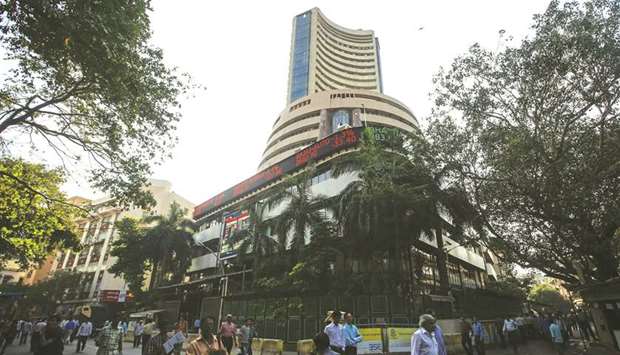
The Bombay Stock Exchange building in Mumbai (file). The Sensex closed down 0.2% to 35,905.43 points yesterday.