


Since the miner’s dam burst disaster on January 25, the Baltic Exchange Capesize Index has more than halved to hit a two-year low, and it’s still dropping.
“Vale’s loss of iron ore export volumes to the tune of 40 to 50mn tonnes is nothing less than an apocalypse for Capesize vessel freight rates,” Bloomberg Intelligence Senior Analyst Rahul Kapoor said. Vale is a “swing factor” in the market, and the impact of the disaster on freight rates is amplified by the sheer distance from Brazil to top buyer China, according to Kapoor.
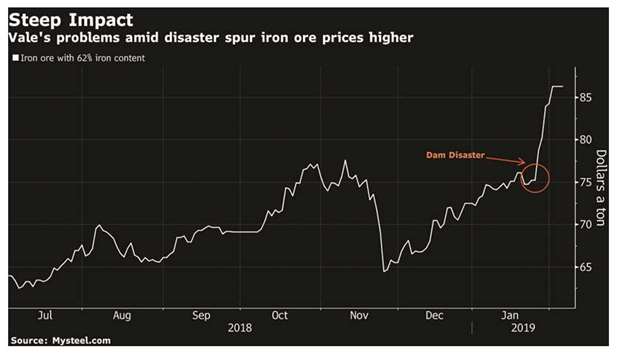
Iron ore is the world’s biggest dry-bulk cargo by volume, with annual seaborne flows totaling about 1.6bn tonnes as vessels carry the key steel-making ingredient from giant mines in Brazil and Australia to users in China and Europe. Vale has announced supply cuts of as much as 70mn tonnes following the dam burst in January, although it’s said some of that decline can be made up. The disruption helped iron ore futures rally to the highest since 2014.
Freight rates are expected to stay under prolonged pressure as some top Australian iron ore miners – Vale’s main rivals including BHP Group and Fortescue Metals Group Ltd – have said that they are unable to boost output to make up for the shortfall, Kapoor said in an interview.
A sea voyage from Brazil’s Tubarao to Qingdao spans about 11,000 nautical miles (20,000 kilometers), and a Capesize vessel traversing the route via the Cape of Good Hope and then returning to Brazil takes 85 to 90 days, according to BI. From Australia’s top gateway at Port Hedland to the same port in China, its 3,500 nautical miles, and the to-and-from passage needs 30 to 32 days. Fewer cargoes from Brazil cut vessel demand on the much longer journey.
The iron ore market’s wave of disruption has come as shippers also contend with the prolonged fallout from the US-China trade battle, although recent talks – including negotiations in Washington this week – may help to pave the way for a resolution. The standoff has hurt some dry-bulk volumes, including flows of soybeans from the US to the mainland.
In iron ore, the exact magnitude of the loss isn’t yet clear. Vale initially aimed to produce 400mn tonnes this year, and it will update the market next month when it releases earnings. To offset some of the drop from mines where dams are closed or it’s lost licenses, production from other sites is being ramped up.
“We have seen reports that Vale’s ore exports could be curtailed by as much as 40mn tonnes,” said Ralph Leszczynski, head of research at shipbroker Banchero Costa & Co.
“This is a big amount, about 2.5% of global iron ore trade. If true, it will have a material impact on the freight market.” Still, Leszczynski adds longer-term context is crucial. While the Baltic Exchange Capesize Index is lower today than it was at this time in 2018, it’s still higher than in several years before that. “In 2015-2017, we have seen even worse markets than what we have now,” Leszczynski said.
Complicating the picture for Vale, thousands of miles away from its mines, a fire broke out this month at a distribution centre in Malaysia, halting operations there for about 10 to 15 days. The Rio-based miner has said it expects minimal impact on shipments because the facility is already scheduled for a 10-day preventive maintenance in the same period.
After an initial surge as Vale’s news was absorbed, iron ore futures have eased off. The most-active contract traded at $84.80 a tonne in Singapore on Friday, little changed this week.
That compares with a February 8 intraday peak of $94, the highest since 2014, and about $75 before the dam burst.