


Global concerns over economic growth made for a gloomy session across equity trading floors yesterday as investors digested weak indicators and tired of hoping for a US-China trade talks breakthrough.
Key European stock markets were all lower at the close, with Frankfurt again the weakest performer after the outlook for German growth, crucial for the eurozone, became the focus of investor jitters.
London’s FTSE 100 closed 0.3% down at 7,071.18 points, Frankfurt’s DAX 30 ended 1.1% down at 10,906.78 points, Paris’ CAC 40 shed 0.5% at 4,961.64 points, while the EURO STOXX 50 lost 0.5% at 3,135.45 points yesterday.
Wirecard shares were the main losers on the German DAX index as fraud allegations piled on top of investors’ concerns about lack of transparency, costing the stock around 13% of its value by the close.
Wall Street was also down in the late New York morning and looked poised to clock up a third straight day of losses.
Earlier, Tokyo led an Asia-wide slump, while Hong Kong returned from the three-day Lunar New Year break also in the red as investors reacted to negative signals from the US ahead of crunch trade negotiations in Beijing.
US Trade Representative Robert Lighthizer and Treasury Secretary Steven Mnuchin are due to travel to China next week for a third round of talks.
But US President Donald Trump told reporters he did not expect to meet his Chinese counterpart Xi Jinping before the March 1 deadline, when US duties on $200bn in Chinese imports are due to jump sharply.
Analysts say Trump meeting with Xi in person ahead of the cut-off would make a meaningful deal more likely, but had flagged the difficulty of matching schedules with the US president flying to Vietnam to meet North Korea’s Kim Jong-un later this month.
The imposition of the tariffs could weaken the global economy after a brief rally at the start of 2019, economists say.
Tokyo closed down 2%, although Sony bucked the trend to soar more than four% after announcing a plan for share buybacks worth up to ¥100bn ($910mn).
Global stocks had already tumbled on Thursday after the European Commission slashed its eurozone growth forecast for this year on an unexpected slowdown in Germany, Brexit woes, tensions over lacklustre growth prospects in Italy, and French protests.
The commission, the EU’s executive arm, is now expecting growth of 1.3% in the eurozone this year, a significant cut from 1.9% predicted in November.
The pound was little changed the day after EU President Donald Tusk warned that there was “no breakthrough in sight” in Brexit talks, while the Bank of England warned the UK economy was “not prepared” for a potential no-deal Brexit.
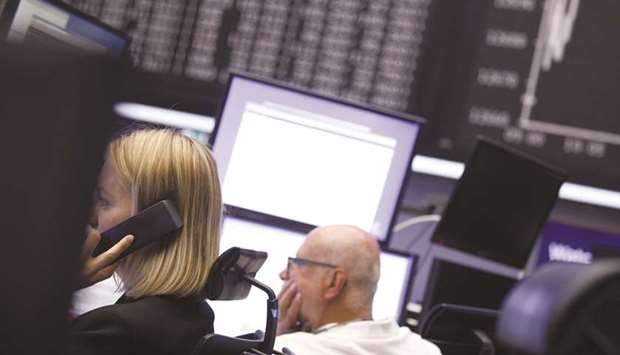
Traders monitor financial data inside the Frankfurt Stock Exchange. The DAX 30 ended 1.1% down at 10,906.78 points yesterday.