


US President Donald Trump has said that sending the military to Venezuela is “an option” as Western nations boost pressure on socialist leader Nicolas Maduro to hand over power to opposition leader and self-proclaimed president Juan Guaido.
The United States, Canada and several Latin American countries have disavowed Maduro over his disputed re-election last year and recognise Guaido as the rightful leader of the economically troubled Opec nation.
Maduro however still maintains the powerful backing of Russia, China and Turkey, whose foreign minister said yesterday that Western meddling was fueling Venezuela’s troubles and punishing millions of its people.
In an interview with CBS yesterday, Trump reiterated that military intervention was a possibility.
“Certainly, it’s something that’s on the — it’s an option,” Trump said, adding that Maduro requested a meeting months ago.
“I’ve turned it down because we’re very far along in the process,” he said on a CBS ‘Face the Nation’ interview.
“So, I think the process is playing out — very, very big tremendous protests.”
Tens of thousands of people thronged the streets of various Venezuelan cities on Saturday to protest his government.
Guaido told his supporters in a major rally in Caracas on Saturday that he would announce when they would seek to bring in international humanitarian aid from Colombia, Brazil and a Caribbean island.
It is unclear whether Maduro’s government, which denies the country is suffering a humanitarian crisis, will let any foreign aid through.
The clock, meanwhile, was ticking on a midnight deadline set by seven European countries demanding that Maduro call presidential elections or see them recognize Guaido as acting president.
During the protest, Guaido announced the installation of collection centres for medicine and food in neighbouring Colombia and Brazil.
At the opposition leader’s request, Washington was already readying “and transporting humanitarian aid” for Venezuela, US National Security Advisory John Bolton said on Twitter.
France warned Maduro of the approaching deadline and that it was preparing to recognize Guaido.
“The ultimatum ends tonight,” France’s European affairs minister Natalie Loiseau told French media on Sunday.
“If between now and this evening Mr Maduro does not commit to organising presidential elections, we will consider that Mr Guaido is legitimate to organise them in his place,” Loiseau added.
Speaking at a pro-regime demonstration marking 20 years since his predecessor Hugo Chavez came to power, Maduro ignored those demands and instead reiterated his call to bring forward legislative elections slated for the end of 2020 to this year. “They want to bring forward elections, let’s have elections,” he said.
Loiseau, the French minister, dismissed Maduro’s threat to hold early legislative elections as “a farce, a tragic farce.”
Maduro, making his first appearance at a rally since a military parade in August when he claimed to have been targeted in an attempted assassination, accused Guaido of being a US “puppet” in a coup d’etat attempt.
The National Assembly is the only one of Venezuela’s five government branches controlled by the opposition.
Guaido had earlier urged the armed forces to allow humanitarian aid from abroad into the country.
“You, soldier...have the decision in your hands” to allow it in or not, said Guaido.
At his rally on Saturday, Maduro called the opposition “imperialist beggars,” claiming the US pledge to deliver $20mn in aid would precede military intervention.
Guaido also called for a new demonstration on February 12, and another protest to push for the entry of humanitarian aid.
The rival Caracas rallies, separated by 10 kilometres (six miles), attracted huge crowds.
Carlos Morales, a 62-year-old who voted for Chavez in 1998 but now says socialism only brings “misery,” attended a pro-Guaido rally with his wife.
“This is the leader that all Venezuelans hoped for, a new leader, young, who is not contaminated,” he added.
At the pro-Maduro demonstration, Virginia Rondon, 69, hummed songs that glorified Chavez, and reminisced about his socialist revolution, saying: “I never experienced anything more beautiful in all my years.”
Others denounced the specter of US intervention and called on the United Nations to halt “Trump’s war.”
The military and security forces have so far been Maduro’s main pillar of support, but there have been signs of unrest in the ranks.
On January 21, a group of 27 soldiers rose up against Maduro in Caracas, although that was quickly suppressed.
It helped spark a week of protests in which 40 people were killed in clashes with security forces, with hundreds more arrested.
The challenge to Maduro is his most serious yet, with the United States leading the campaign to drive him from office.
European and Latin American states have formed a “Contact Group” with a 90-day deadline to try to resolve the crisis, and will meet in Uruguay capital Montevideo next Thursday, the EU said.
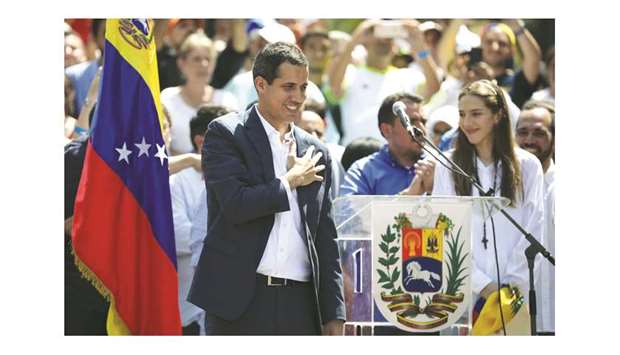
Venezuelan opposition leader and self-proclaimed interim president Juan Guaido takes part in an anti-government rally in Caracas on Saturday.