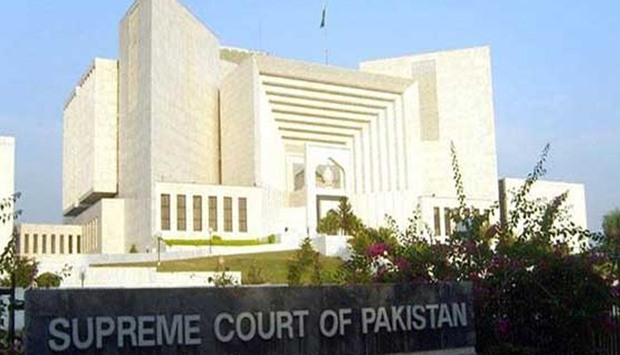
The Supreme Court upheld yesterday the acquittal of Aasia Bibi, a woman who spent years on death row after being convicted of blasphemy, dismissing a petition filed by Islamists who have called for her execution.
The decision leaves Bibi, who has been staying at an undisclosed location under tight security, free to leave Pakistan and seek asylum abroad.
“On merit, this petition is dismissed,” Chief Justice of Pakistan Asif Saeed Khosa told the court, saying that the petitioners, led by a village prayer leader, had failed to point out any mistake in the original judgment, which he said had been based on false evidence.
In November, Canadian Prime Minister Justin Trudeau said his country was in talks with Pakistan about helping Bibi, however there was no confirmation of her whereabouts or intentions following the verdict.
Bibi, a farm worker, was convicted in 2010 of making derogatory remarks about Islam after neighbours working in the fields with her objected to her drinking water from their glass because she was not Muslim.
Her conviction was overturned in October, prompting protests from religious hardliners calling for her death and demanding that the government prevent her from leaving the country.
They also called for the Supreme Court judges to be murdered.
Under pressure from days of protests in the capital, Islamabad, and other cities, the government agreed to stop Bibi leaving the country until the Supreme Court considered the petition.
Following that, the government launched a crackdown on the leadership of the hardline Tehreek-e-Labbaik (TLP) group, which led the protests last year.
Bibi has been in hiding since the Supreme Court freed her in October, after eight years on death row.
She has always denied committing blasphemy.
Hours before the Supreme Court decision, Shafeeq Ameeni, acting head of the TLP, issued a new warning to the court not to rule in favour of the “blasphemer”.
Most of the TLP’s leaders remain in detention after the government crackdown, and few protesters could be seen at the court in Islamabad, where security appeared normal.
That did not prevent the handful who did show up from calling for violence against Bibi prior to the court’s ruling.
“If she goes abroad, don’t Muslims live there?” Hafiz Ehtisham Ahmed, an Islamist activist linked to the extremist Red Mosque in Islamabad, told AFP. “If she goes out of Pakistan ... anybody can kill her there.”
Ameeni was not immediately available for comment after the ruling but in remarks in court, Chief Justice Khosa was severely critical of the petitioners’ attempt to have the judgment reversed.
The top judge said that Bibi had been convicted on false evidence and pointed to discrepancies in testimony in the original case.
“You think we give the death sentence to someone on the basis of false evidence?” Khosa said. “Such lies were told that one statement doesn’t match with another. You start declaring someone deserves to be killed just on the basis of false evidence.”
The chief justice expressed frustration at the furious reaction to Bibi’s case by an extremist minority.
“Is this the face of Islam that we want to show to the world?” he told the packed courtroom.
The chief justice had harsh words for those who first brought the case against Bibi, and the Islamists who over the years have used it to ignite violence, threaten judges, and call for mutiny within the military.
As for the protesters, he was incredulous.
“You block the entire country because a decision is not in your favour?” he told the court.
Ghulam Mustafa Chaudhry, the lawyer who filed a petition on behalf of the cleric who made the original complaint against Bibi in 2009, remained unmoved.
“All religious scholars also verified later that this agreement was wrong. This was wrong,” he said outside court.
The government deployed paramilitary forces and thousands of police across the country to cope with possible protests, however there were no immediate reports of demonstrations.
Rights group Amnesty International called for Bibi to be allowed to “reunite with her family and seek safety in a country of her choice”.
“The authorities must also resist and investigate any attempts to intimidate the Supreme Court,” said Amnesty International’s South Asia campaigner, Rimmel Mohydin.
Moments after the ruling was announced, Bibi’s lawyer Saiful Mulook hinted that his client’s move could be imminent.
“I think at this time she is here (in Pakistan) – but by tonight, I don’t know,” he told reporters outside the court.
Extremists “said they would kill her despite the judgment of the Supreme Court”, he said. “Therefore, I think she should leave the country.”
Unconfirmed Pakistani reports claim her children have already fled to Canada.
Mulook, who returned to Islamabad at the weekend after fleeing to the Netherlands amid death threats following October’s ruling, called the decision a victory for Pakistan’s constitution and rule of law.
The blasphemy row has been linked to two assassinations in Pakistan.
In 2011 Salmaan Taseer, the governor of Punjab province who offered to support Bibi, was assassinated by his own bodyguard in Islamabad.
“Justice! #AsiaBibi” his son Shehryar tweeted after yesterday’s decision.
Taseer’s murder was followed the same year by the killing of minority affairs minister Shahbaz Bhatti, a Catholic, who had also defended Bibi.