


Pakistan has announced a liberal visa regime for the citizens of 175 countries to revive the country’s once-vibrant tourism industry, ruined by years of violence by religious militants.
People from more than 50 countries, including the United States and Britain, would now be able to get on-arrival visas for Pakistan, Inter-Provincial Co-ordination Minister Fehmida Mirza told media in Islamabad yesterday.
The citizens of 175 countries can get online or electronic visas, an option Pakistan had previously not offered, she added.
“We have some of the best tourist places in the world; the mountains, peaks like K2, valleys and deserts,” the cabinet minister said at a press conference, adding: “We want to attract international tourists.”
Pakistani security agencies would ensure the safety of tourists to revive the tourism industry, Mirza said.
The reforms, approved by the cabinet, would open up a new era for the tourism industry, which was devastated by Islamist violence after the September 11, 2001, attacks in the United States, Information Minister Fawad Chaudhry said.
“We have mountain tourism, we have beach tourism,” Chaudhry told reporters in Islamabad, referring to Himalayan peaks and Arabian Sea beaches seldom visited by foreigners. “Pakistan is a heaven for tourists.”
Chaudhry did not identify the countries that would benefit from the new rules but in December, he told Reuters that citizens of most European countries would be granted a visa on arrival.
Tourists would also be allowed to visit the politically-sensitive Himalayan region of Kashmir and other northern areas, which now require special permission.
The new rules would also ease travel restrictions on foreign journalists, Chaudhry said.
Pakistan has half a dozen peaks in the north popular with global mountaineers, including the second-highest in the world, K2, and hundreds of kilometres of coastline in the south and mesmerising deserts.
The new visa regime comes after some countries eased travel advisories on Pakistan in light of improvements in security.
Pakistan was last a prominent tourist destination in the 1970s when the “hippie trail” brought Western travellers through the apricot and walnut orchards of the Swat Valley and Kashmir on their way to India and Nepal.
Since then, deteriorating security and the imposition of a harsh interpretation of Islamic laws has chipped away at the number of visitors.
But security has since improved dramatically in recent years, with militant attacks down sharply in the mainly Muslim country of 208 million people.
Visitors to the country, however, often complained of an arduous visa process, but this looks to change soon with the easing of visa restrictions.
The state Pakistan Tourism Development Corporation said last year tourist arrivals rose to 1.75mn in 2017, media reported.
Minister Chaudhry said that International Air Transport Association (IATA)-approved tour operators can now bring tourist groups to the country under the new policy which, he said, will usher in a new era of progress and prosperity in the country.
“We want to make ‘Naya Pakistan’ a heaven for tourists,” Chaudhry said.
Business visas will now be provided to citizens of 96 countries, an increase from the previous 68 countries, and will be stamped in eight to 10 days, he said.
Chaudhry said the duration of diplomatic visas has been extended from one year to three years, while that of students’ visas to two years from one year.
Tourists can now visit all parts of the country including open cantonments, Azad Kashmir and Gilgit-Baltistan.
They are no longer required to obtain any no-objection certificate (NOC), the minister added.
He said that journalist visas will now be processed through the ministry of information and broadcasting, and they will also be given long-term visas without any curbs.
The new visa regime was approved in a meeting between Prime Minister Imran Khan and Chief of Army Staff General Qamar Javed Bajwa on Thursday.
Potentially restarting tourism has been one of the most talked about parts of Prime Minister Khan’s vision for Pakistan during his government’s tenure.
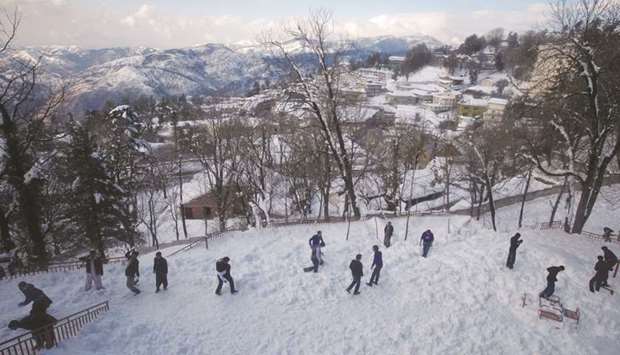
This picture taken in 2012 shows tourists at the hill resort town of Murree, 60km northeast of Islamabad.