


Representatives from the Ministry of Municipality and Environment (MME) and Qatar Environment and Energy Research Institute (Qeeri), part of Hamad bin Khalifa University, participated in the second meeting of the World Scientific Panel on Food-Water-Energy Nexus, held in Berlin recently.
Dr Mohamed bin Saif al-Kuwari, director, Environmental and Municipal Studies Centre at the MME and chair of the Qatar Scientific Research Team, and Dr Abdulkarem Amhamed, senior scientist at Qeeri and technical project lead, took part in the meeting.
The Qatari team discussed the food, water and energy security issues and the way forward for developing a model to understand and investigate the food, water and energy nexus, as well as predicting the amount of water and energy consumption needed to reach the stage of self-sustainability in food, water and energy cycle life.
The participants also discussed the mechanism of involving local experts and specialists in the fields of food, water and energy and benefiting from their experience to support the project.
The Qatar delegation presented a comprehensive plan, which was developed by the Qatari scientific research team, with inputs from national stakeholders.
The plan focused on the efficient implementation of the smart devices and tools to support the developed model to investigate and mimic the real link between the food-water- energy in hot and humid regions.
The new smart devices are expected to provide the optimum water and energy consumption for agricultural irrigation to support Qatar’s food and water security vision and Doha will be the first city in the world to experience this approach in 2019.
Based on the requirements of various crops being planted, these smart electronic systems will control the water levels for irrigation, taking into account the temperature between night and day, humidity and other
elements.
This system has the ability to provide water needed for each single plant in its growth cycle during the day and night, and the system can be monitored and controlled through smart application (phones) remotely. The stages of growth and harvest can also be monitored through the same app.
Under the purview of the International Scientific Research Team, MME will allocate the agricultural area required to apply this scientific approach, which will run for one year to collect the research data for model validation and further development.
At the end of the meeting, the participants agreed to hold the next meeting of the FWE Nexus Research Group in Doha in April 2019.
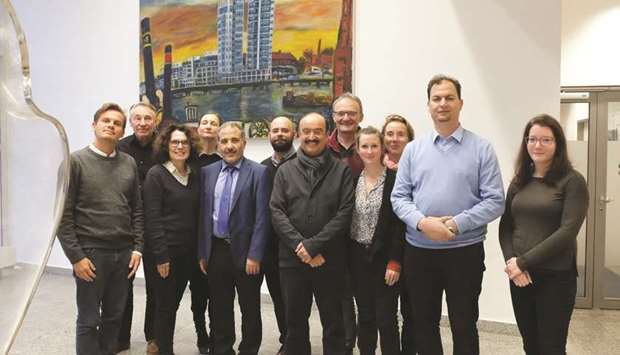
The team of scientists and researchers from Qatar, Europe and America during a meeting in Berlin.