


A fresh wave of winter weather hit Europe’s Alpine countries yesterday, cutting off communities and causing at least one death, several road accidents and an avalanche in southern Germany.
In Austria, a man shovelling snow fell off a roof and died, and a dozen bus passengers were injured in snow-related accidents.
In the town of Faistenau, near Salzburg, four workers were clearing snow from a roof when they lost their footing and dropped 6m to the ground, according to local police.
One of them, a 47-year-old man, was completely buried by snow.
Although helpers began to dig him out immediately, he died at the site of the accident.
In Austria’s Styria province, a long-distance bus veered off the road amid heavy snowfall and slid 12m down a slope.
The driver and 12 passengers were injured in the accident near the town of Aich.
In Slovakia, heavy snowfall and strong winds caused several traffic accidents, bringing roads to a standstill and cutting off the electricity supply of thousands of households.
In the north of the country, around 15,000 households in the Liptau and Orava regions were without electricity yesterday, the regional news agency TASR reported.
In the village of Oravska Polhora near the Polish border, a bus collided with a car on a snow-covered mountain road, but the 51 bus passengers, 47 of them children, were unhurt, according to the fire service.
In Germany, a 300m-wide avalanche struck a hotel in the southern town of Balderschwang.
Police said there were no injuries, though the avalanche did strike with such force that some of the snow made it inside the building.
Access to the town has been cut off since Sunday due to heightened risk of avalanches on the one road leading to the community.
About 1,300 people are stranded there.
A number of Austrian ski resorts and communities were also inaccessible by car yesterday.
Authorities reported 17,000 people stranded in the Salzburg region alone.
The German weather service forecast that snow would stop by early today, giving the region about 48 hours without new snowfall.
However, there could be more on the horizon for Thursday, with snow accumulation in lower altitudes this time, as well as up in the mountains.
Lower-lying regions in Germany – where the temperatures are lower and the snow accumulation less – are seeing flooding as rivers and streams rise over their banks.
So far, authorities are only reporting some flooded fields and meadows, though some residential areas have been warned to be on the lookout.
“Flood waters are slowly coming,” said one police spokesperson.
German Interior Minister Horst Seehofer went to review the snow removal efforts in person yesterday, promising extra help from federal police, while Chancellor Angela Merkel expressed her recognition for all those helping in the Alps.
Switzerland has also been affected, with multiple regions reporting the highest alert levels for avalanches possible.
Road and railroad connections were especially affected in the eastern canton of Grisons.
Swiss authorities have raised avalanche warnings in several regions to their highest levels.
And, just a week before the World Economic Forum’s main annual meeting in Davos, train service to the glitzy ski town in eastern Switzerland has also ground to a halt, national rail service SBB said.
The head of the local government in the town of Disentis, Robert Cajacob, told AFP, that the town’s population of 2,200 as well as “several hundred tourists” currently had no way out because of rail closures and impassable roads.
The official added that the situation was “stable” but “problematic”.
A statement from the national weather office, MeteoSwiss, said that parts of the Alps had seen 60cm to 90cm (24” to 35”) of snow since Saturday night and that another 30cm to 50cm were expected in some parts of the northern Alps in the coming hours.
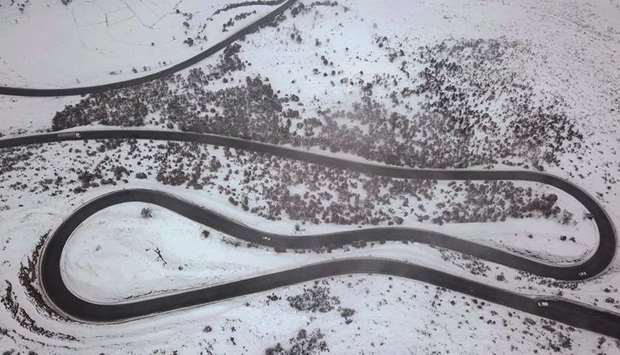
An aerial view shows cars driving a road near Pogradec, Albania, yesterday. Cold weather and snow has engulfed the northern and southeastern parts of Albania in the last week. Local media has reported that at least five people have died due to the low temperatures.