


As parliament in London remains deeply divided on the nature of the Brexit deal, ominous clouds are gathering over the southern port of Dover.
Around 10,000 trucks could be stuck in tailbacks on the roads leading to the famous white cliffs, forced to wait for hours on sections of motorway set aside for the purpose.
Air quality will decline as a result of the transport chaos, government offices will be forced to close with staff unable to get to work, and rubbish could pile up in the streets as refuse trucks become stuck in the traffic.
Children may be unable to get to school, and fresh goods will spoil during transport in the lengthening truck convoys.
These gloomy predictions are not from a disaster movie, but from a study commissioned by Kent County Council.
They could become reality should Britain crash out of the European Union without a deal on March 29.
This scenario is becoming increasingly likely in the face of the deadlocked situation in parliament, where debate on Brexit has resumed after the Christmas and New Year holidays.
A vote on the highly contested deal that Prime Minister Theresa May has hammered out with Brussels has been set down for Tuesday.
The English Channel, no more than 40km wide at this point, forms the most important link between Britain and the European mainland with its Dover-Calais ferries and the Channel Tunnel, particularly for goods that need rapid delivery to their destination.
In the event of a “no deal,” customs checks would have to be imposed from one day to the next, and the entire region would turn into a huge bottleneck, remaining jammed for up to six months, according to the predictions.
Dover residents are in a state of frustration at the lack of information. “We simply don’t know how things will go on,” a worker in the local tourism office says. “The politicians tell us nothing,” she adds.
While the manager of a chemist’s has few concerns on stocking her range, she is worried about her brother.
“He’s an electrician, and he doesn’t know how his business will be able to continue after Brexit,” she says. “If uncertainty leads to people ceasing to build houses, he won’t have work any more.”
The British government authorities are scarcely ready for the looming chaos in Dover, Eric Schweitzer, the head of the German Chambers of Industry and Commerce (DIHK), has warned. “Just-in-time production and supply chains are at risk,” Schweitzer says.
In 2017, the ferries carried more than 2.6mn trucks across the Channel, packed with car parts, medicines and other goods.
In Folkestone, some 10km to the west of Dover, trains enter the Channel Tunnel, also known as the Eurotunnel, carrying trucks laden with containers under the sea floor to France.
Perishable goods could deteriorate if time-consuming checks are imposed with their resultant queues.
Warehouses are already bursting at the seams in Britain in anticipation.
“The amount of storage space needed is simply not there,” says Ulrich Hoppe, head of the German-British Chambers of Industry and Commerce (IHK), in London. “This is an issue particularly with fresh goods, such as food,” Hoppe says.
Around 90% of the medical supplies that are imported into Britain arrive via Dover.
Health Minister Matt Hancock has called on pharmaceutical companies and the National Health Service (NHS) to have six weeks’ worth of supplies in stock.
There are plans to bring emergency supplies in by air.
Last month, Hancock told the BBC that the British government had become the world’s largest buyer of fridges to store the medications.
Roads blocked for months will affect many areas.
Routes to school and hospital will have to be secured, as will transporting the dead to morgues.
In an attempt to alleviate the road traffic situation, as many administrative workers as possible are to be encouraged to work from home for three to six months.
The Road Haulage Association (RHA) said plans for a no-deal Brexit were “dire” and that it would take eight hours to clear an average truck carrying food from Calais to Dover.
London estimates that only 12 to 25% of current capacity could be carried between the two ports in the event of Britain crashing out of the EU without a deal, with trucks stuck in tailbacks stretching for 50km.
Kent County Council’s Paul Carter has urged the national government to provide more information on how they intend to work with the council in the future.
But confidence in the government has been repeatedly shaken.
Former Brexit minister Dominic Raab admitted to the BBC in November that he “hadn’t quite understood” the significance of the Dover-Calais crossing for the country’s goods trade.
He resigned a week later.
Government plans to alleviate the bottlenecks with additional ferry services in the event of a no-deal also came in for scorn after the BBC uncovered the fact that one of the contracts had gone to a shipping company that had not yet started operating.
Transport Minister Chris Grayling defended the contract with the “company with no ships” worth the equivalent of some 17.5mn dollars as promoting a start-up, saying he would “make no apologies for supporting a new British business.” - DPA
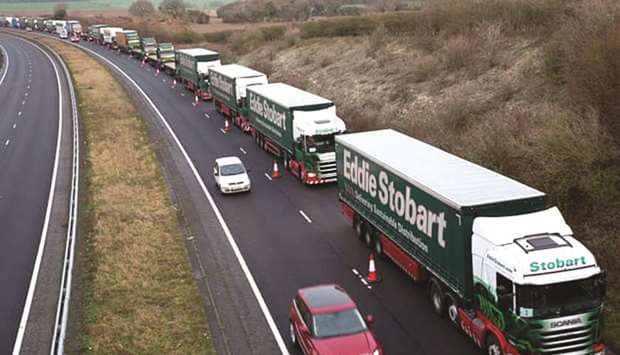
Lorries near Dover taking part in the Department for Transport trial. A live rehearsal of an emergency traffic system was conducted recently to prevent congestion in Dover in the event of a no-deal Brexit. PICTURE: Sean Smith/Guardian