


Italy’s top oil producer and Oman’s energy minister predict the latest oil rebound will stick.
Prices are up more than 20% since hitting an almost two-year low in December, enough to alter Opec+ rhetoric from reassuring investors that it will cut output to taking credit for the rebound, and in the case of Oman, forecasting where oil will trade for the year.
Oman Oil Minister Mohammed al-Rumhi told Bloomberg TV that the agreement between the Organisation of Petroleum Exporting Countries and partners including Russia and Oman can sustain prices at $60 a barrel. He sees crude trading between that bottom and $70 a barrel this year. Claudio Descalzi, the chief executive officer of Italy’s Eni SpA, also told Bloomberg TV the range will be between $60 and $62 a barrel.
A few weeks ago, as global benchmark Brent crude briefly dipped below $50 a barrel, Opec ministers were taking turns to remind investors that they would trim supply. That message, along with brightening prospects for US-China trade talks seem to have worked, pushing the gauge above $60 a barrel and ending talks about an emergency Opec meeting.
“I don’t think we need that,” al-Mazrouei told reporters yesterday, referring to a proposed extraordinary meeting he floated in December. “We are seeing that in December we started the correction. We are expecting we will be achieving the balance in the first quarter.”
Opec agreed to cut oil output this year to support prices. The group and its allies, known as Opec+, agreed to start cutting 1.2mn barrels of daily production this month to stem a surplus and stabilise the market. Producers already reduced output by 600,000 bpd in December.
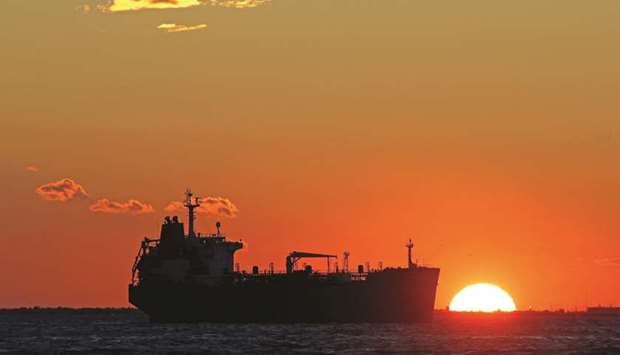
An oil tanker sits anchored off the Fos-Lavera oil hub near Marseille, France (file). Oman Oil Minister Mohammed al-Rumhi has told Bloomberg TV that the agreement between Opec and partners including Russia and Oman can sustain prices at $60 a barrel.