


Oil
Benchmark crude oil futures partially recovered in the first week of 2019 with Brent and WTI gaining 9.3% and 5.8% respectively, after a frustrating last quarter of 2018 that saw oil prices posting a 40% loss. Prices started to receive support from the assumed implementation of the Opec+ deal to cut output by 1.2mn bpd that kicks in this month, especially as Opec output already fell in December by 0.46 mbpd. Prices also got support from resumed trade talks this week between the US and China, and also from expansion in the Chinese service sector that represents almost half of the country’s economy. However, prices got a hit from the sharp build in the US refined product stocks of about 16mn barrels in the week to December 28, and from a contraction in the Chinese manufacturing activity last month for the first time in two years.
According to a Reuters poll, experts expect Brent and WTI to average around $70 and $60 respectively in 2019, as worries about supply excess and a mediocre global economic growth would remain. Whereas, a survey from the Federal Reserve Bank of Dallas shows that US oil companies are using a price range of $50 to $65 per barrel for budgeting purposes. The US shale producers are starting to feel the heat and are slashing their 2019 budgets, while some analysts predict that US oil rig count would fall this year, but this does not mean that the US production would automatically weaken.
Gas
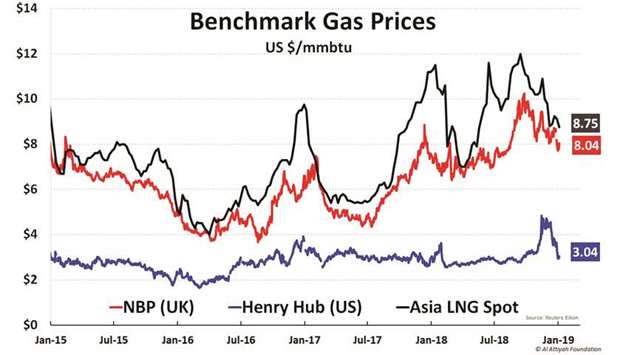
Asian spot LNG prices continued to slide last week with a drop of 3.8% amid still a thin trade following the New Year’s holidays. The Asian spot LNG market is considered as well supplied at the beginning of this year and characterised by a relatively low demand, with some tenders mainly from Pakistan and Mexico. Whereas, the supply side is believed robust with many offers from Australia, the Middle East, and also Malaysia. The shipping rates that fell from their November record of around $200,000 per day to currently about $80,000 are expected to boost the trading activity the coming weeks.
In the US, Henry Hub natural gas futures fell for a fifth straight week by around 8% and totalling almost a 40% drop since early December. The Henry Hub volatility is at its highest levels due to mainly the changing weather forecasts. Meanwhile, UK gas futures increased marginally by 0.7% due to a cold snap reaching its peak. With the price differential between the Atlantic and Pacific basins getting low, the arbitrage opportunities between the two regions are almost non-existent.
This article was supplied by the Abdullah bin Hamad Al-Attiyah International Foundation for Energy and Sustainable Development.
Graph