


New Brazilian President Jair Bolsonaro yesterday issued an executive order making the agriculture ministry responsible for deciding on lands claimed by indigenous peoples, in a victory for agribusiness that will likely enrage environmentalists.
The temporary decree, which will expire unless it is ratified within 120 days by Congress, strips power over land claim decisions from indigenous affairs agency FUNAI.
It hands it to the agriculture ministry, which will now be responsible for “identification, delimitation, demarcation and registration of lands traditionally occupied by indigenous people.”
The move is likely to stoke concern among environmentalists and rights groups that the far-right new president, who took office on Tuesday, will open up the vast Amazon rainforest and other ecologically sensitive areas of Brazil to greater commercial exploitation.
The executive order also moves the Brazilian forestry service, which promotes the sustainable use of forests and is currently linked to the environment ministry, under the control of the agriculture ministry.
Additionally, the decree states that the agriculture ministry will be in charge of the management of public forests.
Bolsonaro, who enjoys strong support from Brazil’s powerful agribusiness sector, said during his campaign he was considering such a move, arguing that currently protected lands should be opened to commercial activities.
Brazil’s 900,000 indigenous people make up less than 1% of the population, but live on lands that stretch for 264mn acres, or 12.5% of the national territory.
Tereza Cristina Dias, Bolsonaro’s new agriculture minister, used to be the head of the farm caucus in Brazil’s Congress, which has long pushed for an end to land measures that it argues hold back the agricultural sector.
Bartolomeu Braz, the president of the national chapter of Aprosoja, a major grain growers association, cheered yesterday’s move.
“We support the initiative of transferring to the agriculture ministry the responsibility of demarcating indigenous land,” he said.
“The new rules will be interesting to the farmers and the Indians, some of whom are already producing soybeans. The Indians want to be productive too,” he added.
Critics say Bolsonaro’s plan to open indigenous reservations to commercial activity will destroy native cultures and languages by integrating the tribes into Brazilian society.
Environmentalists say the native peoples are the last custodians of the Amazon, which is the world’s largest rainforest and is vital for climate stability.
“We are very afraid because Bolsonaro is attacking indigenous policies, rolling back environmental protections, authorising the invasion of indigenous territories and endorsing violence against indigenous peoples,” said Dinama Tuxa, a member of Brazil’s Association of Indigenous Peoples.
A former army captain and longtime member of Congress, Bolsonaro said at his inauguration on Tuesday that he had freed the country from “socialism and political correctness.”
A strong admirer of Donald Trump, Bolsonaro has suggested he will follow the US president’s lead and pull out of the Paris climate change accord.
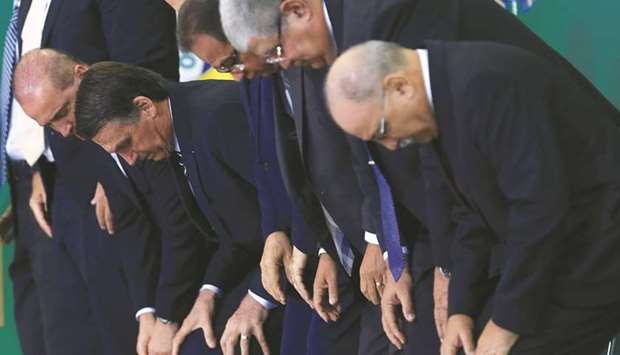
Brazil’s new President Jair Bolsonaro attends the handover ceremony of his new ministers at the Planalto Palace in Brasilia, Brazil, yesterday.