


Joachim Loew is more than happy that the worst year of his tenure as Germany coach is finally over but he now faces the big challenge of fully reshaping his team while at the same time qualifying convincingly for Euro 2020 and being a contender there.
“It is good that 2019 is starting,” he has said, aiming “to fare much better than in Russia” at the continental event played in a dozen countries.
Germany’s shocking group stage exit at the World Cup as title holders in Russia and the ensuing relegation from Nations League A were the low points of 2018 in which Germany lost a record six games.
It was only after a 3-0 drubbing against the Netherlands in autumn that Loew finally started to ring the changes, pledging to give young players a chance.
Players born 1995 and 1996 are now playing a more and more leading role.
Joshua Kimmich (23 years), Timo Werner (22), Niklas Suele (23), Leon Goretzka (23) and Julian Bradt (22) were already part of the squad in Russia, and Leroy Sane (22), Serge Gnabry (23), Thilo Kehrer (22) and 19-year-old super talent Kai Havertz have become important as well.
“The rebuilding is taking place,” Loew said.
But the 58-year-old coach also insists that “the youngsters need stability and orientation” as goalkeeper Manuel Neuer (32) and midfielder Toni Kroos (29 on January 4) remain key members.
But others like Jerome Boateng (30), Mats Hummels (30) and Thomas Mueller (29) are no longer assured starters in a gradual shake-up.
The captain Neuer supports Loew’s changes which also include a different gameplan as a 3-4-3 formation with the fast Sane, Gnabry and Werner has replaced the possession game.
“We have a new spirit in the team but also more speed and skill,” Neuer said.
Five players from the promising 1995-1996 birth years are already in the top 10 with the most minutes after the World Cup debacle (Kimmich, Werner, Suele, Kehrer and Sane) as Loew and German officials set their sights in Euro 2020.
“The Euro is the aim,” German football supremo Reinhard Grindel has said.
Grindel has also insisted that there would be no excuse if Germany didn’t qualify from a group featuring the Netherlands, Northern Ireland, Estonia and Belarus.
The Germans face the Dutch for the first time in the group on March 24, after a friendly against Serbia four days earlier.
The team showed promising football in the second Nations League game against the Dutch in autumn although it blew a two-goal lead in a last-minute 2-2 draw.
But results are now also needed as Loew, with a contract until 2022, no longer appears to be untouchable. A YouGov survey commissioned by DPA has revealed that 41 per cent of Germans no longer consider him the right coach, and only 35 per cent back Loew.
Loew has however been at his best when he had to leave his comfort zone, be it at the 2010 World Cup with fresh faces such as Mueller, Neuer and Mesut Oezil; or in 2014 when the golden generation of Philipp Lahm and Bastian Schweinsteiger shook off the Euro 2012 semi-final meltdown to lift the World Cup trophy.
Internally at the national federation DFB the 2017 Confederations Cup is the highlight of Loew’s tenure as he impressively coached a makeshift and young team to the title.
This achievement is a deciding factor why Loew remains “the best possible national team coach” (DFB vice-president Rainer Koch) despite the World Cup debacle.
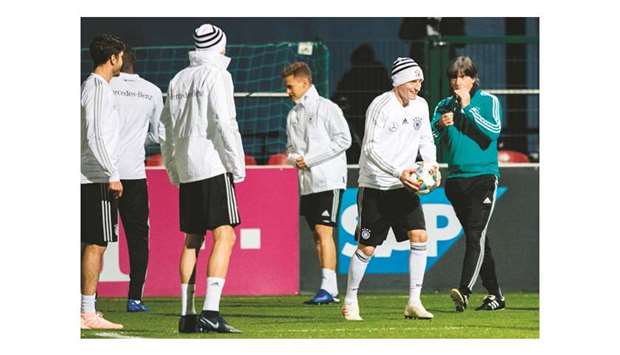
Germany made a shocking group stage exit at the World Cup as title holders in Russia and were relegated from Nations League A under head coach Joachim Loew (right). (AFP)