


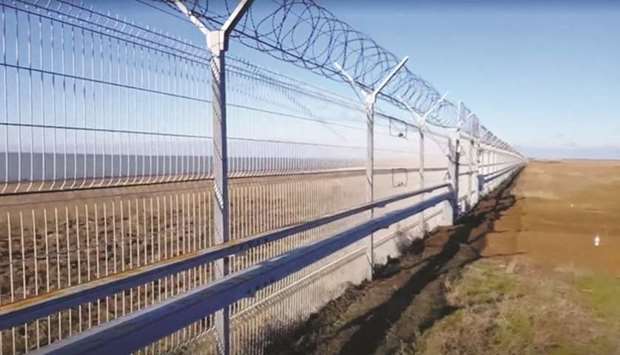
It was necessary to protect the people from the government in Kyiv, from which one could expect anything, a spokesman for the Crimean parliament told the Russian news agency Ria Novosti yesterday.
The border fence in the north of the peninsula will significantly increase the security level, he said.
The European Union regards Russia’s annexation of Crimea as a violation of international law and insists on the territorial integrity of Ukraine.
In fighting between the Moscow-backed separatists and the Ukrainian army mainly in the east of the country, more than 10,000 people have been killed since 2014, according to UN figures.
In the period until shortly before Christmas, 104 dead have been counted so far this year.
In the area of conflict, a truce has been called for today starting at 0.01am (2201 GMT).
According to Ukrainian media, the Ukrainian ambassador to the peace talks with the rebels, Yevgen Marchuk, said: “We stressed that this ceasefire must be used as much as possible for the repair of critical infrastructure facilities that are damaged. Unfortunately, there are several such facilities.”
The ceasefire does not have a time limit and is not just until Orthodox Christmas on January 7, the Organisation for Security and Cooperation in Europe (OSCE) said yesterday.
Germany and France have welcomed the ceasefire agreement.
The upcoming holidays should “be an opportunity for the sides to focus on the needs of the civilian population”,, a joint statement from German Chancellor Angela Merkel and French President Emmanuel Macron said.
Civilians have “already suffered much too long from the conflict and its consequences”, they added, calling for a secure area to allow humanitarian relief.
Last month, there were fears of a new front opening up in the Kerch Strait, a waterway off the coast of Crimea that connects the Black Sea with the smaller Sea of Azov, when Russian forces opened fire and captured several Ukrainian naval vessels there.
The situation in the region has since calmed, but 24 members of the Ukrainian Navy remain in detention in Russia, where they could face up to six years in prison.
Ukraine has insisted upon the sailors being treated as prisoners of war, meaning they would not stand trial.
However, the Kremlin reiterated yesterday that the detainees are to be tried on charges of border violation.
“There are no prisoners of war on Russian territory,” Kremlin spokesman Dmitry Peskov was quoted in Russian media as saying.