Bond traders are all but certain the Federal Reserve will tighten policy this week. The suspense centres on officials’ latest forecasts for interest rates and the economy, which have implications for one of the biggest debates in the Treasury market.
The updated projections come as investors are losing confidence that the Fed will keep hiking amid tame inflation and doubts about global growth. Strategists say a key focus is the Fed’s outlook for 2019, which could dictate whether the inversion seen in some parts of the yield curve becomes more pervasive.
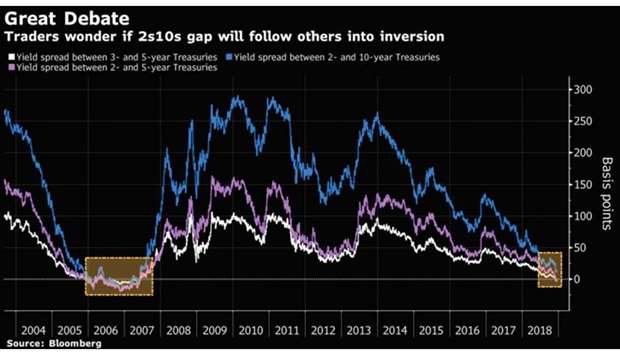
The spread between 2- and 10-year yields is already close to going negative for the first time since 2007.
To Ian Lyngen at BMO Capital Markets, the curve’s next leg is likely lower. Fed Chairman Jerome Powell will probably sound more upbeat on the economy than markets anticipate as he justifies raising rates.
And should policy makers reaffirm plans to hike three more times in 2019 via the dot plot, that will only add to the flattening impulse.
“The real risk will be that the Fed doesn’t change the dot plot, increases fed funds and sounds generally kind of hawkish,” said Lyngen, head of US rates strategy. “That would be a surprise, because I think consensus is now a dovish hike.
So if we get a hawkish hike, that will flatten the curve even further.”
Ten-year Treasuries yield 2.88%, about 15 basis points above 2-year notes. Lyngen says the gap could narrow to the “low single digits” on a hawkish surprise tomorrow, where the dots are unchanged. The prospect of inversion, potentially within weeks, has drawn the attention of investors and policy makers because it has historically served as a recession signal.
Markets have undergone a sea change since the Fed last laid out its projections in September.
The S&P 500 Index set a record high that month, but has since erased its 2018 gains. And the first inversions of the yield curve in over a decade kicked in this month. The spread from 3 to 5 years dropped below zero, before steepening back above zero at the end of last week.
Amid the carnage in equities, the spread between December 2018 and December 2019 euro-dollar futures – a measure of how much tightening traders expect next year – has shrivelled to about 10 basis points. That implies less than one-quarter point hike.
Bryce Doty of Sit Investments Associates expects the Fed to shift its forecasts lower, soothing markets, even though strong US economic data should have Powell sounding optimistic.
Though Doty anticipates a lower 2019 median dot, he still foresees curve flattening because a quarter-point hike would push short-end rates higher.
“That will be the only possible source of relief for stock investors,” said Doty, a senior portfolio manager who helps oversee $16bn. “They’ll say, ‘Okay, he’s really bullish on the economy, but at least we got some good news on the dot plot.”’
What to watch this week: The Fed is the main event, with an expected quarter-point hike tomorrow followed by a press conference with chairman Powell.