


Qatar Petroleum (QP) was able to achieve rapid steps locally and internationally in the oil and gas sector especially in 2018. With regards to exploratory activity in Qatar, a plan to implement a 3D marine seismic survey south Al Khalij field has been set as well as a petroleum trap has been discovered and the required studies to evaluate this discovery and the petrol potential of the area will be taking place.
Preparations have also been completed for drilling an oil well in the area south of Qatar to explore the country’s non-conventional hydrocarbon potential. With regards to global exploratory activities, QP conducted an international technical study to assess the various sedimentary basins at a global level, in co-operation with French Petroleum Institute (IFP). The study will be used to direct QP future plans towards the field of global exploration and production.
In terms of acquisition and global exploration agreements, a consortium including QP (25%), Shell (55% project operator) and China National Offshore Oil Corporation (CNOOC) won the bid held by the Brazilian government in October 2017, for the Alto de Cabo Frio-Oeste block in the prolific Santos hydrocarbon basin offshore Brazil. QP promoted it presence in Brazil by winning along with ExxonMobil (QP 36%, ExxonMobil 64%) a bid for exploration rights for Santos basin. In addition, in its alliance with Exxon Mobil and Brazilian Petrobras (QP 30%, ExxonMobil 40%, Petrobas 30%) QP won exploration rights for two blocks in the Campos Basin in a bid organized by the Brazilian government in March 2018.
In Oman, QP agreed with Eni of Italy to acquire a 30% participating in the Contractor’s interest under the exploration and production sharing located in the Arabian Sea off the coast of Oman. In Mexico, in its consortium with Shell Global (QP 40%, Shell 60%) QP won a exploration rights in four blocks in the Perdido basin, in the eastern part of the Gulf of Mexico in an exploratory tender organized by the Mexican government in January 2018. QP also signed an agreement with US ExxonMobil under which they acquired a 30% stake in two of the latter’s affiliates that that have rights to seven blocks in the Vaca Muerta play in Neuquen in Argentina.
QP also entered into an agreement to acquire a 25% participating interest in the exploration block, offshore South Africa. In terms of production and development, QP’s production in 2017 was about 1.76bn barrels of oil equivalent, about 7.3tn cu ft of natural gas, 210mn barrels of condensate and 232mn barrels of oil, which included QP’s share in global operations.
In Dukhan Field, the implementation of the improved water injection project continues as part of the field’s redevelopment plan for the coming phase. The total production of the field reached 63.02mn barrels of oil during 2017 with a production rate of 172.7 thousand barrels per day. In addition, the rate of production of condensates reached 14.5 thousand barrels per day and natural gas liquids to 68.6 thousand barrels per day.
The implementation of the first phase of the redevelopment of Bul Hanine Oil Field where the drilling began in early 2017 through two offshore platforms and 11.8mn barrels of oil were produced in 2017 at a production rate of about 32.2 thousand barrels per day. For Maydan Mahzam Field a feasibility study for the redevelopment of the field and the selection mode phase for developing the field and 8.3mn barrels of oil were produced in 2017 with a production rate of about 22.7 thousand barrels per day.
For Al Shaheen oil field the transitions of operatorship from Maersk Oil to North Oil Company, which is a joint venture between QP (70%) and Total France company (30%). In 2017, 102mn barrels of oil were produced from the field, producing about 261 thousand barrels per day.
In Al Khalij field, work began on the development plan adopted in 2016, which includes the drilling of new oil wells and improving the level of separation of water in the main station. As much as 6.5mn barrels of oil were produced in the field during 2017 at a daily production rate of about 18 thousand barrels.
In Idd El Shargi North Dome, the first phase of the fifth field development plan has been completed and eight limited platforms have been constructed and connected to allow the drilling of new oil wells. In addition, four new platforms will be constructed during the period from 2018 to 2024. In the field, 29mn barrels of oil were produced during 2017 with a production rate of about 79 thousand barrels per day.
In Idd El Shargi South Dome, 2.9mn barrels of oil were produced during 2017 with a production rate of about 8.4 thousand barrels per day.
Al Rayyan Field has successfully completed the field operation task from Occidental Petroleum for QP to manage and operate the field starting June 1st which is the expiration date of the sharing agreement signed with the company. In 2017, 1.7mn barrels of oil were produced at a daily production rate of about 4.7 thousand barrels.
In Al Karkara Field, 1.8mn barrels of oil were produced during 2017 at the rate of production of about 5 thousand barrels per day, while Bunduq oil field produced 4.3mn barrels of oil during 2017 with a daily production rate of 11.7mn barrels. In March 2018, a new agreement with signed with Bunduq Company, under which the company’s concession was extended for 20 years.
With regards to programmes and projects, QP signed an agreement with Shell to develop LNG marine fuelling or bunkering infrastructure at strategic shipping locations across the globe. QP also announced fuel-oil bunkering solutions for all vessels calling on Qatari ports, which is a first and important step towards self-reliance for fuel-oil bunkering solutions for all vessels since Qatari and non-Qatari-vessels heading to Qatar were using Port of Fujairah. Production of natural gas from the North Field during 2017 was nearly 19.5bn cubic foot per day and the rate of production of condensates was 534 thousand barrels per day.
A comprehensive study for Dukhan Field, which aims to highlight the low production and find appropriate solutions to enhance the capacity of the field, showed more than 100 thousand barrels per day of crude oil can be recovered through the technology of water injection and carbon dioxide alternately and economically. With regards to petrochemical industries, preliminary engineering studies are being carried out to add the sixth furnace to the ethane cracker complex in Qchem to increase production between 20 to 30%. There is also a study to improve the energy efficiency of the production lines of ammonia 1 and 2 in Qatar Chemical Fertilizer Company (Qafco), which could lead to an increase in production by 30 percent by the reuse of the currently wasted energy due to the ageing of the plant.
There is also a study to establish a plant for PVC production, using Vinyl Chloride Monomer (VCM) produced by Qatar Petrochemical Company (Qapco) in order to maximise the added value of this raw material. Employment in the petrochemicals and industries sector has been reduced by 12% on average, while studies continue to rationalise labour in this vital sector.
For the rest of the achievements, Qatargas and RasGas have been merged to create a world-class operator of scale, service and reliability that will create significant opportunities for operating cost savings of nearly QR2bn annually. Qatar Vinyl Company (QVC) has also been merged into Qapco to enhance competitiveness, improve financial performance and provide flexibility for the two companies while providing more robust and sustainable foundations for growth by using the skills, resources and capabilities of the two companies.
QP also launched a forum for offshore field operators to provide a platform for them to work together on continuous improvements in offshore operations, which made nearly $15mn a year. QP is also reviewing developing compressed natural gas (CNG) projects as an alternative fuel for the domestic transport sector, and pledged to implement a major project to use CNG as alternative fuel by 2022.
Among QP’s successes are the construction of storage and distribution facilities for petroleum products to be consumed domestically and the successful operation of the Laffan Refinery 2. This is a significant reflection of Qatar’s strategic expansion in the production and diversification of energy sources, especially as it doubles production capacity by refining an additional 146 thousand barrels of condensates per day from North Field production.
In addition, drilling and maintenance of 148 oil and gas wells in the land and sea fields were carried our, which increased the production capacity of QP fields, and the project of supplying Halul Island with 100km long power cables through Ras Laffan to provide 100 megawatts of electricity for the island and its facilities, as well as the National Security Shield (NSS) project for offshore facilities.
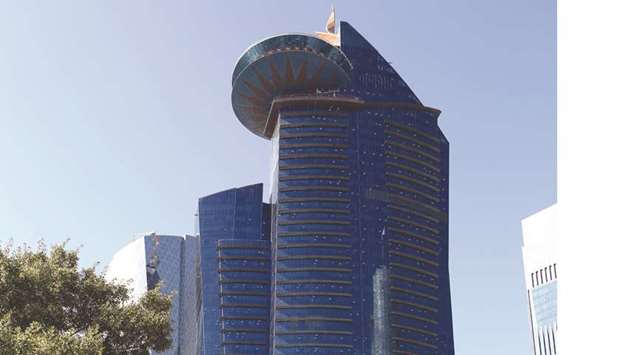
The QP headquarters