


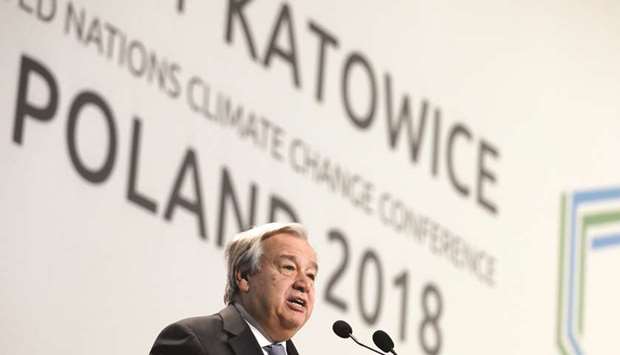
After a string of damning scientific reports showing that humanity must drastically slash its greenhouse gas emissions within the next decade, UN Secretary General Antonio Guterres told delegates at the opening of a UN climate summit: “We are still not doing enough, nor moving fast enough.”
Yesterday, leaders from at-risk nations such as Fiji, Nigeria and Nepal pleaded their case at the COP24 climate talks, which aim to flesh out the promises agreed in the 2015 Paris climate accord.
“Nepal is a country comprised of mountains and plains,” President Bidhya Devi Bhandari told delegates. “We have been bearing the brunt of disproportionate impact of climate change despite being a low carbon-emitting country.”
The Paris agreement vowed to limit global temperature rises to under 2° Celsius (3.6° Fahrenheit) and to the safer cap of 1.5°C if at all possible.
For this, richer nations must provide funding – $100bn per year by 2020 – to steer developing countries towards greener energy while drastically drawing down their own emissions.
But developing nations have complained that richer states – responsible for the vast majority of historic fossil fuel use – are not doing enough to help them adapt to our warming planet.
“We feel as if we have been penalised for the mistakes we never made,” said Bhandari. “It is incumbent on the international community to ensure that justice is done.”
Host Poland – heavily reliant on energy from coal – pushed its own agenda: a “just transition” from fossil fuels that critics say could allow it to continue polluting for decades.
Eighty per cent of Polish energy comes from coal, and the COP24 itself is being held on the site of a decommissioned plant in the mining city of Katowice.
Poland is expected unveil a declaration calling on states to “recognise the challenges faced by sectors, cities and regions in transition from fossil fuels ... to ensure a decent future for workers impacted by the transition”.
Nauru President Baron Divavesi Waqa said the Paris agreement “doesn’t radically disrupt the fossil fuel industry ... these powerful interests emerged from Paris unscathed and we ignore that reality at our peril”.
Proceedings were injected with a shot of glamour as former California governor Arnold Schwarzenegger delivered a surprise address and wildlife documentary maker Sir David Attenborough made a plea to act on behalf of humanity.
“If we don’t take action the collapse of our civilisations and the extinction of much of the natural world is on the horizon,” he said.
Frank Bainimarama, prime minister of Fiji and president of last year’s COP, said that developed nations must act before countries such has his were consumed by the waves.
“Or, God forbid, (we) ignore the irrefutable evidence and become the generation that betrayed humanity,” he said.
None of the world’s largest emitters are represented at the highest level in Poland.
Officials from nearly 200 countries now have two weeks to finalise how those goals work in practice, even as science suggests the pace of climate change is rapidly outstripping mankind’s response.
One of the key disputes is finance.
Under Paris, richer nations are expected to contribute funding that developing nations can access to make their economies greener.
But US President Donald Trump’s decision to withdraw from the Paris accord has dented trust among vulnerable nations, who fear there is not enough cash available to help them adapt to our heating planet.
Yesterday the World Bank announced $200bn (€175bn) in climate action investment for 2021-25 – a major shot in the arm for green initiatives but one which needs bolstering by state funding.
The background to yesterday’s summit could hardly be bleaker: with just 1°C of warming so far, Earth is bombarded with raging wildfires, widespread crop failures and super-storms exacerbated by rising sea levels.
“Even as we witness devastating climate impacts causing havoc across the world, we are still not doing enough, nor moving fast enough, to prevent irreversible and catastrophic climate disruption,” UN Secretary General Guterres said.
The UN’s own expert climate panel in October issued its starkest warning to date.
To have any hope of reaching the 1.5°C goal by the end of the century, it said emissions from fossil fuel use must be halved by 2030.