


It’s not just in the US that confidence in higher interest rates is faltering. Bond and money market traders around the world are reassessing the pace of tightening amid signs global growth is sputtering.
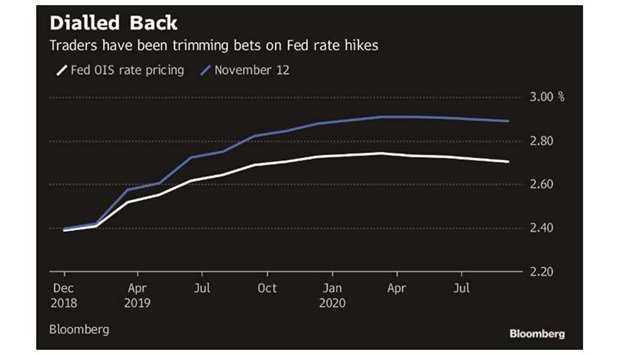
Traders were cutting back bets on Federal Reserve hikes in 2019 even before dovish remarks from Chairman Jerome Powell opened the door for a potential pullback next year. Minutes from the Fed’s meeting earlier last month also set the stage for more flexibility. Meanwhile, the European Central Bank’s long-anticipated rate increase is looking less likely, while the probability of a move in Australia is continually being pushed back.
Central banks may have good reason to turn more dovish. The International Monetary Fund downgraded its forecast for world growth last month, and warned this week that the outlook may have gotten even worse. That’s been reflected in increasing financial market turbulence, with stocks sinking in the fourth quarter and credit spreads widening. Meanwhile, falling oil prices are taming inflation expectations. Here’s how the slowing growth theme is seen playing out in each of the major markets, along with recommendations from strategists on possible ways to trade it.
US: Don’t fade the Fed
US interest-rate pricing shows the market is expecting a 25 basis-point hike this month, and no more than one additional increase next year. That’s less than the consensus among analysts and below the Fed’s own forecasts.
“We’ve reached a tipping point in terms of how much rate hikes by the Fed can be tolerated,” said Yvette Klevan, fixed-income portfolio manager at Lazard Asset Management in New York. “In the US we’re seeing the housing market roll over, mortgage rates touching 5%, and you’ve started to see equity markets correct and head south.” Klevan expects the Fed to pause after raising rates this December and March next year, with any further moves being data dependent.
Europe: Ignoring guidance
While the ECB has been clinging to guidance that rates will rise after the summer, weakening economic data are leaving markets increasingly doubtful. Inflation data for the region released on Friday showed the core reading fell to 1% in November from a year earlier, versus 1.1% prior, while the headline rate slowed to 2% from 2.2%. Overnight swap rates are only pricing in the first full 15 basis-point hike for March 2020.
The central bank won’t tighten next year because macro risks and personnel changes will make the move difficult, NatWest Markets strategist James McCormick says.
The company recommends a cocktail of long positions in the front-end, including a bet on forward Eonia rates and two-year German notes.
Australia: Slow progress
A cooling global economy is especially significant for Australia given the nation’s place in the global supply chain. Markets are pricing in around a 50% chance of a rate hike by the Reserve Bank of Australia in the fourth quarter of next year, with a slowing housing market seen as the major obstacle.
As growth slows, there may be another year of stable RBA policy, Sally Auld, a senior strategist at JP Morgan Securities Australia Ltd in Sydney, wrote in a client note. The company recommends going long Australian rates through receiving short-dated interest swaps versus the US. Still, with unemployment falling, “the case for an RBA rate hike in 2019 is pretty compelling,” NatWest’s McCormick said. He recommended going long Australian dollars versus the Canadian and New Zealand currencies.
UK: Brexit dominates
For the UK, everything depends on the outcome of the vote to leave the European Union. The next 25 basis-point hike from the Bank of England isn’t fully priced in until March 2020, reflecting a hefty Brexit discount. Strategists are optimistic. There is a consensus view a hard Brexit will be avoided, allowing the BoE to gear up rate hikes earlier than priced. A variety of trades expressing this view are being recommended for 2019. McCormick recommends being short gilts and long sterling, while Societe Generale’s Kurpiel advises using swap rates to position for a steeper spread between two- and five-year contracts.
Canada: A little crude
Rate hike odds in Canada have been trimmed as global oil prices slump, though with the nation’s economy closely tied to the prospects of its southern neighbour, markets are still primed for two 25 basis-point moves in 2019.
Declining commodity prices mean markets are now underpricing rate hikes as the Bank of Canada is likely to tighten three times in 2019, says TD Securities Senior Canada Rates Strategist Andrew Kelvin. The bank recommends a variety of short positions in near-dated interest rates including positioning for a higher rate hike premium for the March 2019 policy meeting and also in the fourth quarter.
Japan: Outside chance
Most strategists have ignored the front end of Japan’s interest-rate curve when making their predictions for next year, and with good reason.
The gentle upward slope of the overnight rates curve shows minimal rate-hike expectations are priced in. But some see the chance for action. The Bank of Japan will raise its short-term rate by 10 basis points to zero in April 2019 – ending its negative interest-rate policy – with a view to making the overall easing framework more sustainable, Morgan Stanley MUFJ strategists, including Koichi Sugisaki in Tokyo, wrote in a client note.
graph2