


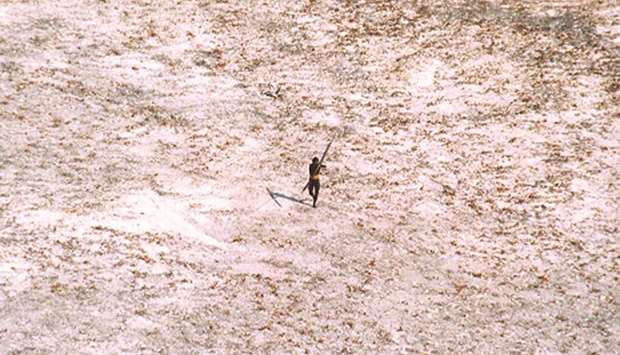
He believes that John Allen Chau, the young Christian from the United States who was killed after trying to make contact with them, would be alive today if he had respected their wishes to be left alone.
As regional head of the Anthropological Survey of India, Pandit had on several occasions led teams of researchers and government officials to develop contact with the Sentinelese.
DPA: How do you think this incident could have happened?
Pandit: I am shocked by the tragedy of a young man getting killed, but in the circumstances it is possible.
Sentinelese normally don’t go out of their island, they don’t attack anyone.
They can show friendly gestures if the mood is there, if the circumstances are there, but my experience is that they would not like us to land on their island. We should respect their wish to be left alone.
DPA: Why do you think they attacked Chau?
Pandit: I think this young man persisted when the Sentinelese made it very clear they did not want him there, an arrow was shot at him which hit his Bible — that is written in his diary.
At that point he should have gone away.
He went away but came back — he provoked them when they made it clear he was not welcome.
He should have listened to them.
DPA: You have taken expeditions to, or near the island. What were your experiences?
Pandit: Our first trip was in 1967 with help of the Andaman administration. At first the Sentinelese hid in the jungle and we did not see them. Sometimes we would land for a short while and come back, we would not stay there. They allowed us to drop gifts along the shore and move back to a safe distance. This happened repeatedly, we have done trips through the 1970s and the 1980s. After several expeditions, in 1991 they allowed us to approach them. In 1991, they came forward to receive gifts in hand from us. They did not attack anyone, they did not shoot arrows, we waded into shallow waters and they received gifts of coconuts in their hands. We don’t know why they allowed us near. But they did not invite us to come ashore. When I got too close to the shore one young boy took out his knife and I immediately moved back and got on the boat. The gift-giving stopped in the mid-1990s and now there is an “eyes only, hands off” policy, as we have seen what infections from outsiders have done to the Jarawa tribe.
DPA: But since then the Sentinelese have been more aggressive; they killed two fishermen in 2006. What do you think changed?
Pandit: They have no trust in outsiders and they will not allow people to come ashore and stay put there. For them, outsiders are intruders. They don’t know how they will behave, what will be their intentions, what they will do there in terms of their world views. They may have had some bad experience, some poachers may have tried to come into these islands for poaching fish and may have had encounters with them. We do not understand the language they speak but it was not difficult to understand that they did not want us on their island.
DPA: What chance is there that Chau’s body would be retrieved?
Pandit: It is a matter of working out a safe strategy and a matter of luck. Maybe the Sentinelese will allow parties to take out the body. It is anybody’s guess. They may not obstruct perhaps as they may not want the body to be there.
DPA: Can the body pose a danger to the tribe?
Pandit: It can. Any of us can be a source of infections. Because...disease taken to the Andaman Islands by the settlers in the early 19th century did a lot of damage to the indigenous people — a lot of tribals died of all kinds of infectious diseases including measles. Even minor diseases are passed on. They have no cure for it. All our team members underwent health checks before the visits.
DPA: What do we know about the Sentinelese?
Pandit: They are hunter gatherers, they don’t have agriculture.
They are totally dependent on nature for their food supply — the forest and the sea. They probably hunt wild boars.
They use small canoes in shallow waters to fish.
DPA: The 2011 census counted 15 Sentinelese.
What is your estimate of their number?
Pandit: My estimate is there are about 80-100 of them, but not 15.
We have seen larger numbers coming on the shore in 1991.