


Charms of Urdu poetry continue to spellbound millions of people around the world. The creative works in the language finds its true expression in the countries and among people where Urdu is not the first language.
Alok Kumar Srivastava, pseudonym Shaz Jahani, is a poet who learnt the language primarily after falling in love with Urdu poetry. He also learnt Urdu transcript much later in his life only to understand and appreciate the poetry of classic Urdu writers. His enthusiasm and craving for the language and creative skills are recognised in India.
Alok is currently in Qatar and Community caught up with him to talk about his life and works.
Tell us about yourself
I’m 70 years old and come from Noida, Uttar Pradesh in India. My mother tongue is Hindi. I have a son who lives in London and a daughter in Qatar. I did my Masters in Physics from Indian Institute of Technology Kanpur.
I joined the Indian Air Force in 1972 and worked in its meteorological branch. I retired as a Group Captain in 2005. After my retirement, I had stints as a registrar with a university, as a chief administrative officer in a private company, and then, as a consultant meteorologist at Indigo Airlines.
How and when did your love for Urdu poetry start?
I come from a Hindu background and I know Devanagari script. Like many other boys of my age, I was very fond of movies and songs. I could understand and appreciate the movie dialogues and songs as they were mostly in Urdu, but I did not know the Urdu script back then.
My first ever introduction to real and classic Urdu poetry was in 1966 when I completed my graduation from Jabalpur University.
On one occasion, just to pass time during a train journey, I bought a copy of Deevaan-e-Ghalib in Devanagari script. I was totally unfamiliar with the words. Fortunately, the meanings of most of the words were available in the book, but I had to check the meaning of almost each word. I could cover only nine pages. However, this effort was so enjoyable and educative that I could not leave the book thereafter. Then, I regularly started buying Urdu poetry books in Devanagari script.
When did you start writing your own poetry?
After joining the air force, there was a lull for a couple of years in my pursuit of poetry. However, my posting to Leh (Ladakh) gave me plenty of time to devote my attention to it. It was there when I started writing my own poetry. I had a dictionary for Urdu synonyms (in Devanagari script) of common Hindi words used in poetry. It made my search for Urdu words easier. I started writing ghazals but I did not know the Urdu script. I also had no idea of basic essentials of the Urdu prosody. Obviously, there were flaws in my initial writings.
My collection of ghazals, published with the name Khwabon ka Shor in 2005 was full of flaws. I chose the pen name Shaz because I considered myself different from others.
I had not stayed at one place for a long period of time; I could not link my name with any particular city. So I added Jahani, meaning ‘of this world’.
How did you learn Urdu script?
With the passage of time, I realised that the knowledge of Urdu script was essential, and I learnt it through a correspondence course conducted by National Council for Promotion of Urdu Language in India. To minimise my errors in prosody, I bought and studied different books available on the subject. It has improved my Urdu writing and I have started appreciating the true essence of the poetry.
What kind of poetry you like the most?
I belong to the school of classical Urdu poetry lovers. I enjoy and respect the works of poets like Ghalib, Dagh, Josh, Faiz, Iqbal, Jigar, Shakeel, Sahir etc. I have had the good fortune of sharing the stage with many poets belonging to the classical school.
I do not dislike modern thought and techniques, but my heart is in traditional and classical poetry. I have been active on different literary groups on the social media. The digital literary groups have given a fillip to Urdu poetry and its beauty.
What are your future plans?
I will keep writing poetry and reading classic poets. I enjoy social media groups that help me improve my work. It helps improve my verses. I do not have a plan to publish a book but I will, however, compile a digital book.
How do you see the future of Urdu poetry?
It has a very bright future. It is melodious and sweet. Many people are creating excellent works not only in India and Pakistan, but also in other countries of the world.
I have been visiting London and Doha regularly to see my children. I see lots of Urdu literary activities happening in both the cities. I have met some very good writers in Doha. The city is also known for hosting these literary gatherings. I love to be around here.
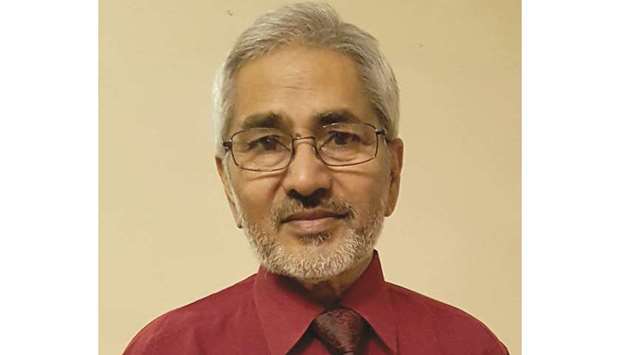
POET: Alok Kumar Srivastava learnt the language primarily after falling in love with Urdu poetry.