


Airbus delivered its first A330neo jet to TAP Portugal yesterday as it seeks to trump US rival Boeing in the fiercely competitive battle at the lower end of the market for long-haul jets.
The face-off between the A330neo and Boeing 787 pits two generations of jetliner against each other in one of the most crowded but potentially lucrative parts of the aircraft market, predicted to represent $1tn in sales over 20 years.
Airbus said its upgraded A330neo, seating 250-298 passengers, would dovetail with the European plane maker’s hot-selling A321neo narrow-body jet, which seats about 200, in the race to address a gap between single-aisle and twin-aisle jets.
Boeing is weighing up proposals to develop a new-generation jet carrying 220-270 passengers in a development analysts say could severely hurt the A330, the most profitable Airbus series.
The European plane maker is attempting to close its jaws around the same part of the market through a combination of the A330-800neo and the smaller A321neo, industry strategists say.
Sales of the A330neo have fallen short of expectations in the face of heavy competition from Boeing’s 787, but the head of Airbus twin-aisle marketing predicted that it would hold its ground in the same way as the current A330 has done after Boeing was hit by production delays on the 787.
Despite weighing more than Boeing’s 787 because of its metal structure, Airbus says the A330neo saves airlines money because of a more efficient wing.
Boeing, however, says the lightweight composite design of its 787 wins on economics despite its higher sticker price.
The aircraft delivered to TAP Portugal yesterday is the 298-seat A330-900neo, the larger of two versions developed by Airbus and one that dominates the tally of 242 aircraft on order.
The smaller A330-800neo took its first flight this month.
Airbus launched the revamped A330neo series in 2014 after failing to win as many orders as it had hoped for the A350-800, the smallest version of its own new-generation composite jet, the A350, which competes with most 787s and the larger 777.
The first A330neo delivery was delayed by setbacks at Britain’s Rolls-Royce, which recently rescheduled deliveries of the Trent 7000 engine as it focuses on resolving difficulties with a sister engine that powers some Boeing 787s.
Leasing company Avolon financed the first TAP A330neo, with Singapore-based BOC Aviation involved in helping the Portuguese airline to finance progress payments ahead of yesterday’s delivery. Meanwhile, Airbus SE will offer airlines a modified version of its A330neo wide-body designed for shorter trips to help combat the new middle-of-the-market plane that Boeing Co is expected to launch next year.
The A330neo’s engines could be re-rated to a lower level of thrust, helping to reduce the fuel load and cut its take-off weight, Crawford Hamilton, the plane’s marketing chief, said in an interview yesterday in Toulouse.
He spoke after Airbus handed over its A320neo to TAP.
That would make the model better-suited to the mid-range routes Boeing would target with its jet, dubbed the 797. While the A330 will remain a bigger plane, Airbus is seeking to chip away at the overall market for the new Boeing, with versions of the A321neo narrow-body already eating into the lower end of the same niche with a spate of sales to trans-Atlantic carriers.
The A330neo’s maximum take-off weight stands at 242 metric tonnes, but that could be cut to 200 tonnes, while its Rolls-Royce Holdings Plc engines could be re-rated to 68,000 pounds of thrust from 72,000 pounds, Hamilton said.
The Airbus aircraft, a re-engined version of a model that traces its heritage to Airbus’s original A300 model, has been struggling for sales against Boeing’s 787 Dreamliner, a completely new design that utilises a largely composite construction to slash fuel consumption.
Hamilton said the mere fact that the A330 is still around shows that the 787 “failed in its mission,” adding that while the Airbus plane is heavier, its higher seat count delivers better cost-efficiency per passenger. In the early years the original A330 also sold slowly before demand picked up, he said.
Airbus is also targeting the A330neo as a replacement for the Boeing 767, which is of a similar size and discontinued as a passenger jet, and even for the larger 777, older examples of which are nearing retirement, Hamilton said.
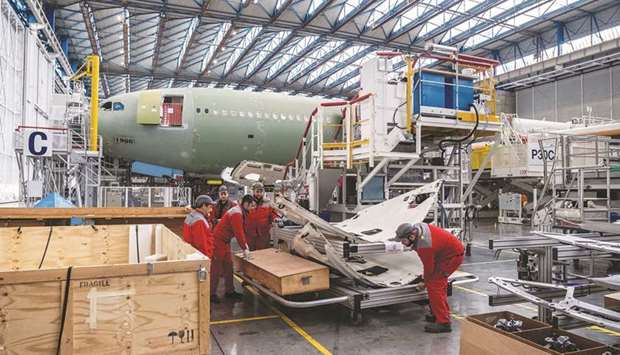
Employees manoeuvre fuselage panels as an Airbus A330neo passenger aircraft stands on the final assembly line at the Airbus factory in Toulouse. Airbus said its upgraded A330neo, seating 250-298 passengers, would dovetail with the European plane maker’s hot-selling A321neo narrow-body jet, which seats about 200, in the race to address a gap between single-aisle and twin-aisle jets.