


European Union leaders finally sealed a Brexit deal yesterday, saying the package agreed with Prime Minister Theresa May was the best Britain will get in a warning to the British parliament not to reject it.
“Those who think that, by rejecting the deal, they would get a better deal, will be disappointed,” European Commission president Jean-Claude Juncker told reporters after the 27 other EU leaders formally endorsed a treaty setting terms for British withdrawal in March and an outline of a future EU-UK trade pact.
Asked whether there was any chance Brussels would reopen the pact if an alliance of pro- and anti-Brexit forces votes it down in the British parliament, Juncker said “this is the best deal possible”, although summit chair Donald Tusk sounded more guarded, saying he did not want to consider hypotheticals.
May used a post-summit news conference to make a sales pitch for her plan, telling television viewers at home that it was the “only possible deal”, offering control of UK borders and budgets while maintaining close alignment with EU regulations that was good for business and the security of Britain and Europe.
“In any negotiation, you do not get everything you want. I think the British people understand that,” said May, who arrived after the endorsement to voice hopes for continued close ties.
Parliament’s vote could open the door to a “brighter future” or condemn the country to more division, she said. “I will make the case for this deal with all my heart,” she added, declining to answer whether she would resign if parliament rejects it.
German Chancellor Angela Merkel, the bloc’s veteran guiding force, echoed that unwillingness to speculate on what she called a “historic day” that was both “tragic and sad”.
“There is no Plan B,” said Dutch Prime Minister Mark Rutte.”If anyone thinks in the United Kingdom that by voting No something better would come out of it, they are wrong.”
The only Plan B was preparing a possible no-deal scenario in which Britain crashes out on March 29 into legal limbo, roiling Europe’s economy, a senior EU official said.
In May’s exchanges at the summit, there was no discussion of what may happen if parliament rejects the deal in a vote likely to take place just before the next EU summit on December 13-14.
Amid praise for Michel Barnier’s team of negotiators for bringing home a deal after 18 months of gruelling talks, Juncker said it was “no time for champagne”, as one of Europe’s great powers quits after a 2016 referendum.
The harder work of forging new relations now lies ahead, he added.
The EU leaders took barely half an hour to rubber-stamp the 585-page withdrawal treaty, aimed at an orderly exit in March to be followed by two to three years of a status-quo transition period.
The outline of a future trading and security partnership was just 26 pages long.
May’s critics say it leaves Britain tied to EU regulations that it will no longer have a say in setting.
Her foreign minister, Jeremy Hunt, said that the Brexit deal was a “staging post” towards Britain getting everything it wanted from leaving the EU, but that the arithmetic for getting the deal approved was “challenging”.
European Council president Tusk said the bloc was determined to have as close as possible a partnership with Britain, which has long been sceptical about EU integration: “We will remain friends until the end of days. And one day longer,” he said.
French President Emmanuel Macron said Britain’s Brexit vote showed Europe needed reform.
He stressed that Paris would hold Britain to tight EU regulations, in return for giving it easy trade access.
He also foreshadowed coming, fraught, negotiations by demanding access to British fishing grounds after Brexit.
Lithuanian President Dalia Grybauskaite spoke of several scenarios if parliament blocks the package: that Britons would hold a second referendum; hold a new election to replace May or return to Brussels to try and renegotiate the package.
Northern Ireland’s Democratic Unionist Party, which props up May’s minority government, said it would try to block the deal because it binds London to many EU rules and the DUP fears it may weaken the province’s ties to Britain — a result of efforts to avoid a risk of a “hard border” with EU member Ireland.
Wrangling over how to keep open troubled Northern Ireland’s land border with the EU dogged much of the Brexit talks and DUP leader Arlene Foster said she would “review” the agreement to back May’s Conservative government if the Brexit divorce is passed in parliament.
Opposition leader Jeremy Corbyn repeated that his Labour party, which says it could get a better deal, will vote against.
Britain’s 300-year-old naval base in Gibraltar on Spain’s southern coast, had also threatened to derail plans.
But Prime Minister Pedro Sanchez said he was satisfied with guarantees of a say in the future of “The Rock”, saying on Sunday that Spain wanted to claim a share of sovereignty.
What if MPs reject Brexit deal?
Prime Minister Theresa May faces an uphill struggle to win approval for her newly-agreed Brexit deal in Britain’s parliament next month.
A defeat in the House of Commons, where lawmakers have voiced strong opposition, would have uncertain consequences.
Britain has legislated to leave the European Union on March 29, 2019, after triggering Article 50 — the treaty mechanism used to exit the bloc — two years prior.
May has warned that if MPs vote down her plan the country risks crashing out on this date with no agreement.
That would sever ties overnight with its closest trading partner, with fears of grounded flights, medicine shortages and gridlocked ports and motorways.
Dozens of arch-Brexiteers, led by a hardline backbencher, Jacob Rees-Mogg, believe no deal would be preferable to the current plan that keeps the country tied closer to the bloc.
But that view lacks majority support in parliament.
Lawmakers have vowed to stop it happening.
But it remains unclear how they could reverse the law passed to leave the EU.
They fear Britain and financial markets would be thrown into chaos, with even Finance Minister Philip Hammond sounding alarmed.
“If we were to leave the EU without a deal I have no doubt that the consequences for the UK economy would be very serious indeed, very disruptive, and very negative for jobs, for prosperity in the future,” he told the BBC.
MPs are expected to vote on May’s plan on or around December 10, with an EU summit set for later that week.
If they reject her deal, the prime minister may head to Brussels, aiming to finesse elements of the plan to win support at home.
Bloc leaders have warned they will not return to the negotiating table.
But with the threat of a no-deal Brexit — which would have deleterious consequences for EU countries — they could relent.
The Sunday Telegraph newspaper reported that several British cabinet members and EU diplomats were secretly working on “plan B” proposals.
The senior ministers were said to be plotting the parameters of a relationship with Brussels similar to that applied to Norway, which is not an EU member but is in the European single market.
Although being in the single market would require maintaining freedom of movement of EU citizens into Britain — a contentious issue for May and many pro-Brexit voters — this approach is considered more likely to command a majority in parliament and potentially pass a second vote.
Meanwhile, EU figures are said to be “war-gaming” how the bloc could extend Article 50 to allow for a tweaked deal or other scenarios, the Telegraph said.
Beyond those scenarios, the situation becomes even more uncertain. Conservative lawmakers could restart a stalled bid to replace May as party leader.
That would require 48 MPs — 15 % of the parliamentary party — to initiate an internal contest, and a majority then supporting a rival.
Meanwhile, the prime minister could try to break the parliamentary deadlock by calling a general election — but would need the backing of two-thirds of all MPs.
A simple majority of all lawmakers could also topple her government with a vote of no confidence.
That could lead to the formation of a new government — possibly a coalition of parties — if MPs agreed within two weeks, or then an election.
The likelihood of May downfall has risen amid signs of strain in her Westminster alliance.
The Democratic Unionist Party, a fervently pro-Brexit party in the UK’s Northern Ireland which props up her government, has said it could withdraw its support over the issue.
In a warning shot earlier this week, it withdrew support for government finance legislation.
Alternatively, calls for a so-called “People’s Vote” — a new referendum — now attract significant cross-party support.
May has repeatedly ruled out another referendum.
But with at least a dozen Tories and opposition parties increasingly in favour, she could face a majority pushing for it in the House of Commons amid the paralysis.
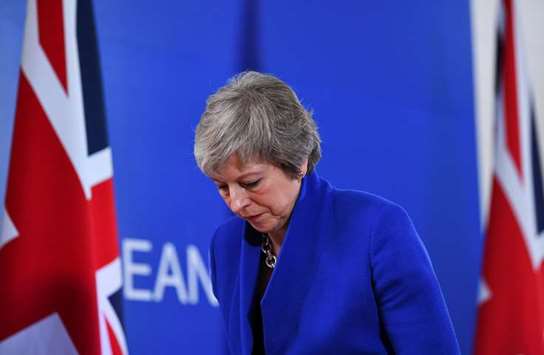
Prime Minister Theresa May leaves after a news conference following an extraordinary EU leaders summit to finalise and formalise the Brexit agreement in Brussels, Belgium, yesterday.