


The Bank of Russia said it will give “more certainty” to the market by the end of the year about when it plans to resume regular purchases of foreign currency and will make its decision based on rouble volatility.
“We will make the decision about resuming foreign-currency purchases by assessing market volatility and our near-term estimates of volatility,” governor Elvira Nabiullina said in an interview in Almaty, Kazakhstan. “The exchange rate for this or that period of time won’t play any role. We aren’t targeting the exchange rate.”
In September, the central bank suspended purchases, which it uses to boost Russia’s reserves, until the end of 2018 when it pushed through an unexpected interest rate hike to stem a slide in the rouble.
Nabiullina reiterated that the country isn’t in a tightening cycle, but said the bank is worried about inflation following the rouble’s 13% slide this year and due to a forthcoming raise in value-added tax.
“It’s still not obvious if the VAT increase will cause a prolonged increase in inflation expectations and secondary effects, such as price growth for other goods,” Nabiullina said. While the central bank has committed to maintaining its pause on currency buying until the end of the year, the odds of a resumption after that look increasingly likely as the imminent risk of new US sanctions abates. The purchases matter for investors because they prevent the currency of the world’s biggest energy exporter from moving sharply with the price of oil.
The rouble retreated as much as 0.4% to 66.21 per US dollar yesterday after Nabiullina’s comments, paring a weekly rally.
In normal times the central bank buys foreign currency on behalf of the finance ministry when oil prices are above $40 a barrel to help build up reserves and increase Russia’s resistance to external shocks.
Without the pause, the regulator would have bought about $30bn since August, according to Bloomberg calculations.
The central bank plans to buy the foreign currency it didn’t accumulate in the second half of this year when markets stabilise, but hasn’t decided yet when or how it will do that, Nabiullina said.
One option may be to spread the purchases evenly over three years, she said.
Nabiullina estimated that inflation may peak at 6% in the first half of next year from 3.5% in October.
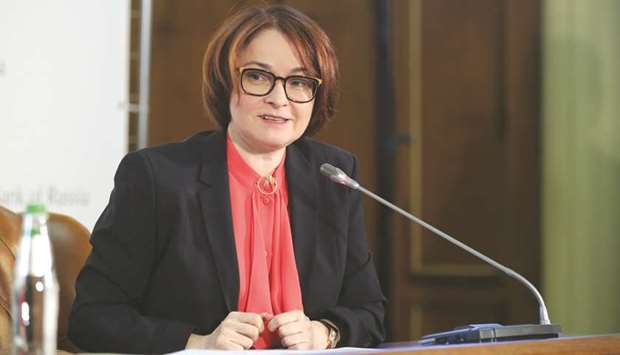
Nabiullina: Reiterating that the country isn’t in a tightening cycle.