


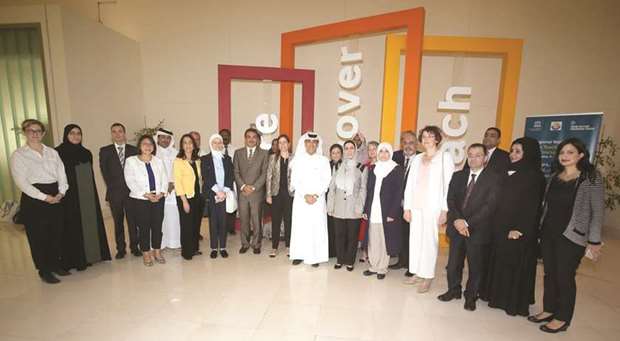
A group of 25 participants from Qatar and the wider region convened at WCM-Q for the four-day Regional Ethics Teacher Training Course, which is designed to advance pedagogical capacity for ethics teaching and improve the quality of ethics education around the world. The course forms part of a multifaceted capacity-building strategy designed to help Unesco member states address ethical issues arising from rapid progress in medical and life sciences.
The programme was opened by Dr Ibrahim bin Saleh al-Nuaimi, undersecretary of the Ministry of Education and Higher Education; Dr Khaled Machaca, WCM-Q associate dean for research; and Dr Anna Paolini, director of the Unesco Doha office.
The course, which was jointly hosted by WCM-Q’s division of Continuing Professional Development and the Research Division, taught participants the principle methods and methodologies for the teaching of ethics, identified key learning resources, and provided assessment and feedback on the teaching skills of each participant, under the guidance of experienced teachers.
The interactive course featured lectures, group work, individual demonstrations, and group discussions, led by trainers of the Unesco bioethics team. Among the topics addressed by the course were patient rights, privacy, confidentiality and informed consent; the UN Universal Declaration on Bioethics and Human Rights; dignity and ethics for professional educators; and bioethics teaching in the Arab World.
Dr Thurayya Arayssi, WCM-Q senior associate dean for Medical Education and Continuing Professional Development, said, “Ethical behaviour demonstrates our commitment as physicians, researchers and healthcare professionals to always act in the very best interests of patients and research subjects. As such, a sound understanding and a solemn appreciation of ethics is absolutely fundamental to the correct practice of medicine and biomedical research.”
Dr Machaca gave the welcome address. He said, “Qatar has experienced extraordinary growth in its healthcare and biomedical research sectors in recent years, establishing itself as a leading research hub in the region. During this period of rapid growth, Qatar has shown resolute commitment to ensuring the rights and dignity of those using the healthcare system and those generous individuals who chose to participate in human subject research for the greater good. This important course will contribute significantly to enhancing and facilitating the ethical issues at play.”
Dr Paolini stated, “Ensuring the equitable distribution of the benefits of science as well as ‘health wealth’ to address inequalities within and among nations, is a central challenge to achieving the 2030 Development Agenda. In the Arab region, while bioethics is gaining recognition as an effective means to address ethical conflicts in medical treatments and research, actual interpretation and implementation of universal principles in practice differ and are influenced by cultural aspects.”
Ministry sets deadline for contest on Qur’an memorisation
The Ministry of Education and Higher Education yesterday announced that the deadline for participation in the 58th annual school competition in memorising the Holy Qur’an for the 2018/2019 academic year is February 9, 2019.
The competition is held annually in co-ordination between the Ministry of Education and Higher Education and the Ministry of Endowments and Islamic Affairs (Awqaf), in line with the message of the State of Qatar in caring for the Qur’an and honouring its people, spreading its teachings among the students, and instilling its sublime manners in them in every way and effort.
The ministry called on the supervisors of Islamic education to give the opportunity to all students, without exception, wishing to participate throughout the period of registration, and to take care of them, and applying to the competition from all stages, by memorising the prescribed parts. Prescribed parts have been illustrated in co-ordination with parents with attention to good performance and strict control.
It also directed all schools to form a committee to follow up the protection of students before the date of the competition.
The ministry aims to carry out these competitions to preserve the Qur’an in the generations, and to preserve the Arabic language because it is the language of the Holy Qur’an, and sharpen the motivation of the students to compete in the fields of science, and to educate generations created by the morals of the Qur’an.
The tests run on February 17 and are open to Qataris and residents enrolled in public or private schools, provided they receive a personal number from the Directorate General of Immigration, passports and nationality, and the applicant chooses to participate in one of the first levels or the second shall not be combined, and the applicant shall abide by the curriculum according to the years of study, and shall not have won an award in a similar contest in the same amount or more in the past years.
Participation in the second tier is permitted only for those who memorise seven or more connected parts of the Qur’an or hereafter, and the keeper of the whole Qur’an is not allowed to participate again until one year later. (QNA)